
How Smart Rings Measure Heart Rate: PPG Accuracy and Data Gaps
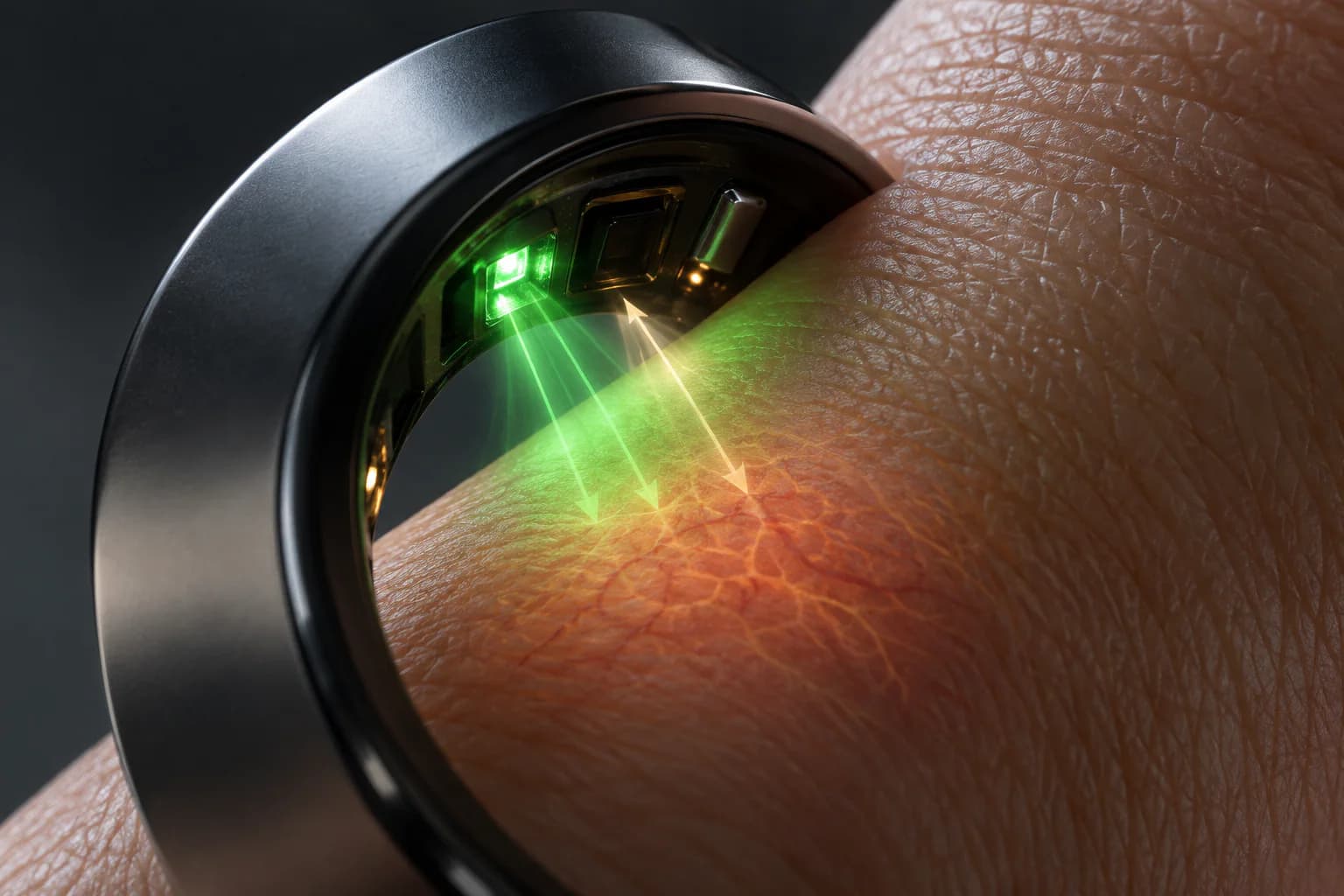
Short answer: Most smart rings estimate heart rate with photoplethysmography (PPG). LEDs illuminate tissue in the finger, a detector records pulse-related changes in reflected light, and software converts the repeating waveform into beats per minute. The result is generally most useful during sleep and quiet rest. Movement, gripping, cold fingers, poor fit and weak signal quality can create delay, error or missing data.
A smart ring does not listen to the heart. A standard PPG ring also does not record the electrical waveform of an electrocardiogram (ECG). It observes a mechanical consequence of the heartbeat after the pulse wave has reached the finger.
That distinction explains why a ring can provide useful overnight and resting trends while struggling during weightlifting or rapid hand movement. It also explains why an optical pulse rate, ECG heart rate and manual pulse count may not match at exactly the same second.
This guide follows the complete path from light to BPM, separates spot readings from all-day trends, and gives you a practical protocol for checking an unexpected value.
The Measurement Chain at a Glance
| Stage | What happens | Common source of error |
|---|---|---|
| Illumination | LEDs send selected wavelengths into tissue | Poor contact or blocked sensor |
| Optical detection | A photodetector measures returning light | Ambient light, pressure or movement |
| Pulse extraction | Software separates the pulsatile component | Motion can resemble the pulse frequency |
| Peak timing | The algorithm identifies pulse-wave cycles | Missed or extra peaks |
| Rate calculation | Intervals are converted into BPM | Short windows can change quickly |
| Quality filtering | Unreliable sections may be discarded | Creates gaps rather than false precision |
| Display and summary | Values are sampled, averaged or graphed | App timing may lag the current pulse |
| User interpretation | The number is compared with context | One reading can be overinterpreted |
The final app value is therefore a processed estimate, not raw light data and not a direct view of the heart.
What Heart Rate Means
Heart rate is the number of heartbeats per minute. It changes normally with:
- movement and exercise;
- sleep and circadian timing;
- posture;
- heat and cold;
- hydration;
- emotions and mental workload;
- caffeine, nicotine, alcohol and other substances;
- medication;
- illness and fever;
- age, fitness and individual physiology.
One BPM value rarely explains its own cause. For wellness tracking, the more useful outputs are often:
- the overnight curve;
- resting patterns under similar conditions;
- response to supported activity;
- how quickly the rate settles after demand;
- repeated deviations from a personal baseline.
“Lower is better” is not a universal rule. A low rate can be normal for one person and concerning in another depending on symptoms, medication and health context.
How PPG Turns Light Into a Pulse
Photoplethysmography is an optical method for observing changes in blood volume in tissue near the skin.
1. LEDs illuminate the finger
Wearables often use green light for pulse-rate sensing because hemoglobin and surrounding tissue create a usable contrast at shallow depth. Some devices also use red or infrared wavelengths for other supported optical measurements.
The exact wavelengths, LED positions and power-management strategy differ by product.
2. Blood-volume change alters reflected light
After the heart contracts, a pressure wave travels through the arteries. The local blood volume in finger vessels changes over the pulse cycle. This changes how much light is absorbed and returned to the detector.
The signal contains:
- a slowly changing component related to tissue, average blood volume and contact;
- a smaller pulsatile component associated with each pulse wave;
- noise from movement, pressure, electronics and the environment.
3. The detector records a waveform
The photodetector converts light into an electrical signal. The raw waveform does not yet equal BPM.
4. Software removes interference
Filters and motion data help separate likely pulse components from baseline drift and movement. An accelerometer can show when hand movement overlaps with the optical pattern.
5. Pulse peaks are identified
The algorithm finds repeating features and estimates the time between them. If a peak is missed, the calculated rate can briefly look too low. If motion creates a false extra peak, it can look too high.
6. Intervals become BPM
If pulse cycles are 1,000 milliseconds apart, the rate is approximately 60 BPM. If they are 500 milliseconds apart, it is approximately 120 BPM.
Apps may smooth several intervals rather than display every instantaneous calculation. Smoothing improves readability but creates delay during rapid changes.
Why the Finger Is a Useful Measurement Site
The finger has a rich peripheral blood supply and can provide a strong optical pulse signal under suitable conditions. A ring also encloses the measurement site, which can help maintain contact and reduce some ambient-light exposure.
The benefit depends on fit and use:
- A stable ring can collect long, low-motion nighttime segments.
- A loose ring can rotate and change the optical path.
- A tight ring can be uncomfortable and alter local contact conditions.
- Cold can reduce peripheral perfusion.
- Gripping can compress tissue and move the ring.
Finger placement is an opportunity, not a guarantee of accuracy.
Does a Smart Ring Measure Every Heartbeat Continuously?
Not necessarily. “Continuous” and “all-day” are often used loosely.
A ring may use several modes:
- Periodic background sampling: short measurement windows spaced through the day.
- Longer nighttime windows: more frequent or sustained sampling during sleep.
- On-demand reading: the user starts a spot measurement while still.
- Workout mode: a supported activity triggers a different sampling strategy.
- Event or quality-based sampling: frequency changes according to motion, battery or signal quality.
The app graph may interpolate, average or omit low-confidence periods. A smooth line does not prove every heartbeat was recorded, and a blank section does not always mean the heart-rate feature failed.
Product communication should name the sampling behavior rather than equating all-day trends with uninterrupted clinical monitoring.
Resting, Overnight and Workout Heart Rate
Resting heart rate
Low movement gives PPG a cleaner waveform. A ring can be useful for comparing resting measurements taken at a similar time and posture.
“Resting” is not just “not exercising.” Walking to the chair, drinking caffeine, talking, posture and recent stress can affect the result. Compare standardized moments rather than random app checks.
Overnight heart rate
Sleep offers long low-motion periods. The overnight curve can show when heart rate settles, its broad minimum and whether it remains elevated relative to recent nights.
Alcohol, late meals, heat, illness, hard training, medication and sleep disruption can all affect the pattern. The ring cannot identify the cause from heart rate alone.
Workout heart rate
Exercise adds several challenges:
- Rapid physiological change.
- Hand and arm movement.
- Gripping and tissue compression.
- Sweat and shifting contact.
- Vibration from equipment or terrain.
- Algorithm smoothing and display delay.
A ring may provide a broad supported exercise trend. Athletes who need precise second-by-second zones, intervals or safety-critical monitoring should use an appropriately validated sports or medical device for that purpose.
Remove rigid rings for weightlifting, climbing and activities where they can catch or be crushed. Safety takes priority over collecting a workout.
Smart Ring, Chest Strap and ECG
| Device | Signal | Strength | Limitation |
|---|---|---|---|
| Smart ring PPG | Peripheral optical pulse wave | Passive day/night trends and comfort | Motion and contact affect signal |
| Wrist optical monitor | Peripheral PPG at wrist | Live sports display and broad availability | Wrist motion and fit challenges |
| Chest strap | Electrical cardiac signal, commonly single-lead style | Rapid exercise-rate changes for many sports uses | Requires chest contact and model-specific validation |
| Clinical ECG | Electrical activity from defined leads | Rhythm and waveform assessment | Requires appropriate equipment and interpretation |
These tools are not interchangeable simply because they all show BPM. A ring estimates pulse rate at the finger; ECG observes electrical activation. Pulse arrival occurs after the electrical event.
Heart Rate and HRV Are Not the Same
Heart rate reports how often beats occur. HRV describes variation in timing between accepted beats or pulse waves.
A clean average heart rate can sometimes be calculated even when pulse timing is not precise enough for high-quality HRV. Conversely, an irregular rhythm or artifact can make apparent variability high without representing healthy autonomic variation.
Read the separate HRV smart-ring guide for RMSSD, PRV and baseline interpretation.
How Heart-Rate Accuracy Is Evaluated
A responsible validation names the exact model, firmware, reference, population and activity.
Mean absolute error
MAE averages the absolute difference between device and reference BPM. It is easy to understand but can hide a few very large errors.
Mean absolute percentage error
MAPE expresses error as a percentage. It can behave differently at low versus high heart rates and should not be used alone.
Bias and limits of agreement
Mean bias shows systematic over- or underestimation. Bland–Altman limits show how widely individual observations may differ, which is more useful than a small average alone.
Correlation
Correlation shows whether values rise and fall together. A device can correlate strongly while remaining consistently delayed or offset. Correlation is not agreement.
Coverage
Accuracy on retained clean segments can look excellent if difficult segments are discarded. A good study should also report how much data was usable.
Conditions
Resting, sleep, walking, running, cycling and resistance exercise must be assessed separately. One quiet-night result cannot establish high-intensity workout accuracy.
What Research Suggests
Wearable PPG research shows that optical pulse sensing can perform well under favorable low-motion conditions. Motion artifact remains a central engineering challenge.
A study comparing a ring's nighttime heart rate and HRV with ECG reported good performance for the specific Oura model and participants tested. That evidence demonstrates what a tested finger-worn system can achieve; it does not validate every ring or algorithm.
Systematic reviews of wearable PPG and HRV similarly find stronger results during rest than non-stationary exercise. Product-specific claims should therefore be supported by product-specific testing.
Factors That Reduce Accuracy
Loose fit and rotation
Changing contact allows light leakage and movement between sensor and tissue. Use a snug, comfortable size rather than forcing a smaller ring.
External pressure
Sleeping on the hand or gripping a handle changes local tissue and contact. The signal may differ even without visible ring movement.
Rapid movement
Motion can overlap with the pulse frequency. Repetitive movement may be especially difficult because it creates a rhythmic optical artifact.
Cold fingers
Reduced peripheral perfusion can weaken the waveform. A cold ring may also fit more loosely.
Sweat, lotion and residue
Material between sensor and skin can change contact or cause the ring to move. Keep the inner surface clean and dry according to product guidance.
Skin and individual optical factors
Skin characteristics, anatomy, vascular physiology, tattoos and other optical factors can affect signal performance. Hardware wavelengths and algorithms determine how well a product handles variability.
Irregular beats
PPG observes peripheral pulses, not the ECG waveform. Some electrical beats may produce a weak peripheral pulse, and artifacts can resemble irregularity. A standard heart-rate feature cannot diagnose the rhythm.
Battery, firmware and settings
Low battery, disabled features, power-saving behavior or an update can change coverage. Check technical causes before interpreting a missing period as physiology.
Why Heart-Rate Data Has Gaps
| Gap pattern | Possible cause | First check |
|---|---|---|
| Entire night missing | Battery, recording, account or sync problem | Battery history, permissions and synchronization |
| Short daytime gaps | Periodic sampling or movement rejection | Product sampling behavior and activity |
| Gaps during exercise | Motion, gripping, sweat or unsupported mode | Activity support and ring contact |
| Gaps on cold mornings | Weak peripheral optical signal | Hand warmth and repeated pattern |
| Reading appears after a delay | Smoothing or app synchronization | Timestamp and refresh status |
| Sudden change after update | Algorithm or firmware behavior | Version and update date |
| Persistent gaps at rest | Fit, sensor contamination or hardware issue | Clean, re-seat and contact support |
An honest device may show a gap rather than publish a low-confidence number. Missingness is itself a data-quality signal.
A Five-Minute Check for an Unexpected Reading
This check does not diagnose a condition. It helps distinguish an obvious measurement problem from a repeated observation.
Step 1: respond to symptoms first
If you have chest pain or pressure, fainting, severe shortness of breath, new confusion, sudden weakness or feel seriously unwell, seek urgent care according to local guidance. Do not spend five minutes troubleshooting the ring.
Step 2: stop and sit quietly
End movement and relax the hand. Note whether the app value is current or a delayed graph point.
Step 3: inspect fit
Confirm the ring has not rotated, lifted or become painfully tight. Dry moisture and remove visible residue.
Step 4: warm naturally if cold
Allow cold hands to return to a comfortable temperature. Do not apply extreme heat.
Step 5: repeat through the supported on-demand method
Use the product's specified still-reading procedure. If appropriate, compare with a validated device or a manual pulse count performed correctly.
Step 6: record context
Note time, posture, recent activity, caffeine, medication, symptoms and whether the result repeated.
Repeated unexpected readings or associated symptoms deserve professional discussion even when the ring later looks normal.
How to Read a Heart-Rate Trend
Compare similar windows
Nighttime values should be compared with other nights; seated morning values with similar morning values. Random daytime readings are confounded by activity and posture.
Establish a personal range
Use several ordinary weeks rather than the lowest or highest single value. A personal trend is not a medical normal range.
Add related information
Review sleep, HRV, temperature, activity, alcohol, illness and medication context. Several coordinated changes can be more informative than one isolated BPM value.
Look for persistence
One outlier can be noise. A repeated shift under comparable conditions deserves closer attention.
Let symptoms outrank the chart
A reassuring trend does not make chest pain safe. An elevated trend without symptoms also does not reveal a diagnosis.
Common Interpretation Mistakes
“My rate is lower, so my fitness improved”
Fitness can influence resting rate, but medication, sleep, illness, measurement conditions and other factors also matter. Look for a sustained trend with performance and context.
“The ring and treadmill disagree, so one is broken”
They may show different timestamps, smoothing and sensors. Compare synchronized values under a known protocol before judging.
“A high rate means anxiety”
Anxiety can raise heart rate, but so can movement, heat, dehydration, stimulants, illness and many other causes. BPM cannot identify the cause.
“No alert means my rhythm is normal”
A general pulse-rate feature may not analyze rhythm or may lack regulatory authorization for alerts. Absence of an alert is not a clinical clearance.
“More samples always mean more accurate data”
Sampling frequency cannot compensate for poor contact or motion. Quality and validation matter as much as quantity.
Can a Smart Ring Detect an Arrhythmia?
A general PPG heart-rate feature should not be used to diagnose atrial fibrillation or another rhythm disorder. Some specifically authorized wearable functions can screen for certain rhythms, but that evidence applies only to the exact feature, device, market and intended use.
PPG may show irregular pulse timing or fail to obtain a clean value. It cannot identify the electrical mechanism without appropriate rhythm assessment.
Discuss palpitations, fainting, chest discomfort, severe breathlessness or repeated unusual readings with a qualified professional.
When to Seek Medical Help
Seek urgent medical help according to local guidance for symptoms such as:
- chest pain, pressure or tightness;
- fainting or near-fainting;
- severe shortness of breath;
- new confusion or sudden weakness;
- a sustained very fast or slow pulse with feeling unwell.
For non-emergency repeated changes, save the dates and context and discuss them with a healthcare professional. Consumer data can support the history; it does not replace examination or ECG.
Reading EnergyMo Heart-Rate Data
EnergyMo organizes supported pulse-rate observations alongside sleep, HRV, activity, temperature and recovery-related context.
Use the data in this order:
- Confirm the relevant period was actually recorded.
- Check whether the ring was still and correctly fitted.
- Compare the same time or sleep window with recent history.
- Review HRV, sleep and activity context.
- Note symptoms, substances, illness, medication and environmental factors.
- Look for repetition before changing a routine.
Check the current EnergyMo Ring details, supported features, fit guide and HRV guide for related information.
Frequently Asked Questions
How does a smart ring measure heart rate?
PPG LEDs illuminate the finger, a detector records pulse-related changes in reflected light, and software filters the waveform and converts pulse intervals into BPM.
Does a smart ring measure heart rate continuously?
It depends on the model and mode. Many rings use periodic background windows, longer nighttime sampling and on-demand readings rather than storing every heartbeat continuously.
Is a smart ring accurate for resting heart rate?
A validated, well-fitted ring can provide useful low-motion resting and overnight trends. Accuracy remains model-specific and depends on contact, circulation, signal processing and the person tested.
Why does my ring show gaps in heart-rate data?
Common causes include periodic sampling, motion rejection, loose fit, rotation, cold fingers, weak perfusion, low battery, settings and incomplete synchronization.
Why does my ring disagree with a chest strap?
They use different signals, locations, smoothing and timestamps. Optical pulse arrival also follows the heart's electrical event. Disagreement may increase during rapid exercise changes.
Can a smart ring detect an irregular heartbeat?
A standard PPG rate feature cannot diagnose the rhythm. Only rely on a rhythm function for its specifically authorized intended use, and seek professional advice for symptoms or repeated concerns.
Is a tighter ring more accurate?
Not automatically. The goal is stable skin contact without pain, numbness, color change or swelling. Excess pressure is unsafe and does not guarantee a better waveform.
Is one high heart-rate reading dangerous?
One value cannot answer that question. Respond to symptoms first, check whether the reading is current and valid, and repeat appropriately. Seek urgent care for concerning symptoms regardless of the app.
Sources and Editorial Notes
This article distinguishes optical pulse rate from ECG heart rate and does not transfer validation from one product to another.
Sources reviewed:
- Wearable PPG technology for cardiovascular monitoring
- Ring measurement of nocturnal heart rate and HRV compared with ECG
- Sources of inaccuracy in photoplethysmography for cardiovascular monitoring
- Systematic review of wearable PPG-based heart-rate monitoring during exercise
- FDA: General Wellness Policy for Low Risk Devices
- FDA: Pulse Oximeter Basics and optical measurement limitations
Last reviewed: October 12, 2026. EnergyMo SmartRing is a consumer wellness product. Heart-rate trends are not intended to diagnose, treat, cure or prevent disease.