
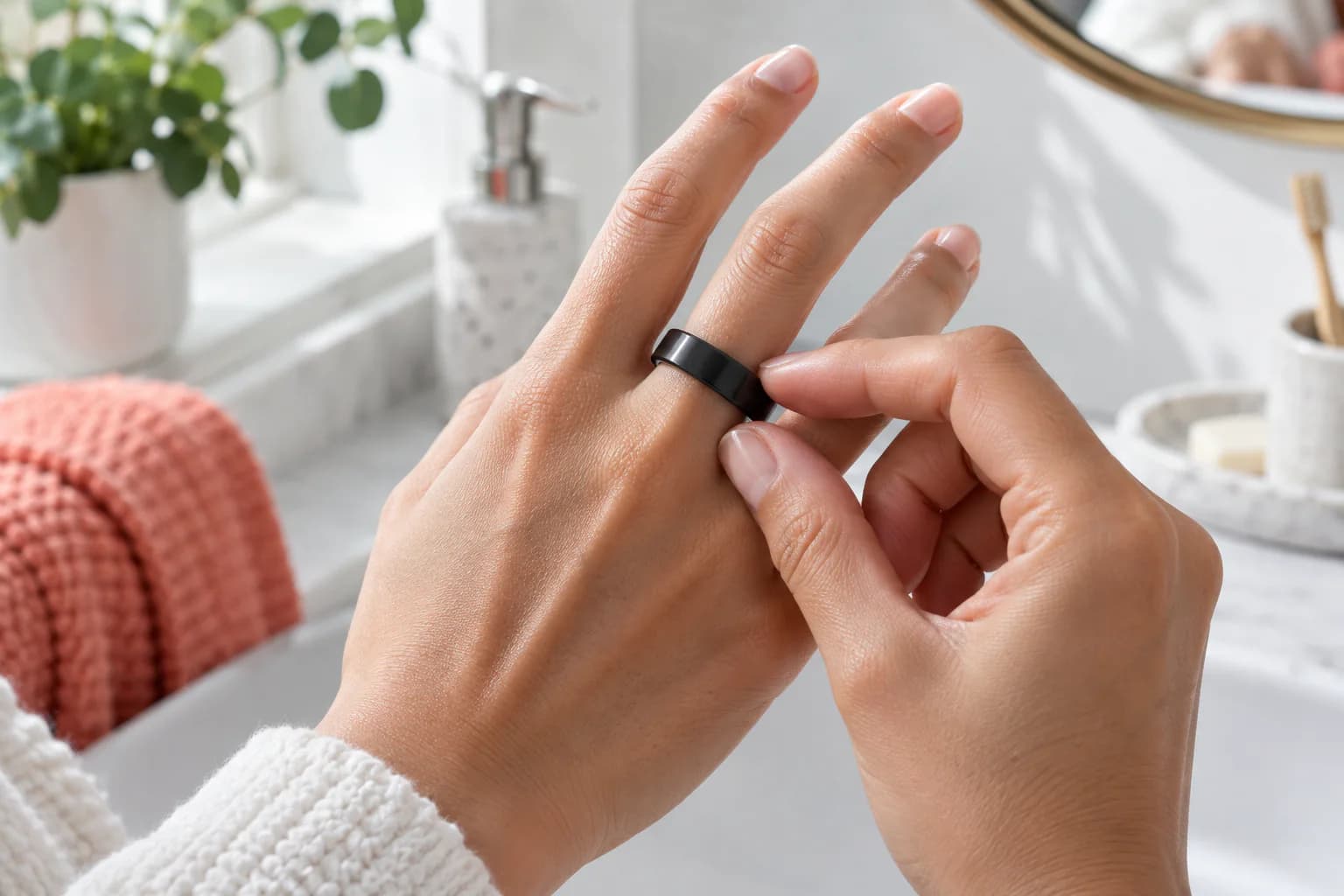
Short answer: A smart ring should feel snug enough to keep its sensors in steady contact with your skin, but never tight enough to cause pain, numbness, tingling, discoloration or persistent pressure marks. It should resist casual rotation, pass over the knuckle with gentle resistance and remain comfortable through a full day and night.
One of the most common smart-ring sizing mistakes is assuming that tighter always means more accurate. It does not.
Optical sensors need stable skin contact. They do not need constant pressure. A ring that is painfully tight can be unsafe and difficult to wear consistently, while a loose ring can rotate, lose contact and produce missing or noisy data.
The goal is a fit you can comfortably forget about—not a ring you have to monitor all day.
Why Fit Matters More for a Smart Ring Than a Regular Ring
A decorative ring can move slightly and still do its job. A health-tracking ring contains sensors that need to remain close to the skin.
Many smart rings use optical PPG sensors to observe pulse-related blood-volume changes. They may also include temperature and movement sensors. If the sensing surface repeatedly lifts away from the skin or rotates out of position, the app may have less usable data for heart rate, HRV, sleep and other trends.
Fit affects three things at once:
- Signal contact — whether sensors remain against the intended part of the finger.
- Comfort — whether you can wear the ring throughout the day and during sleep.
- Safety — whether normal changes in finger size can occur without painful compression.
A ring that performs well for ten minutes but becomes uncomfortable overnight is not the correct size.
What Does “Snug, Not Tight” Actually Feel Like?
“Snug” can sound subjective, so use several practical checks instead of relying on one sensation.
At the base of the finger
The ring should sit securely near the base of the chosen finger. It should not slide toward the knuckle during ordinary movement.
When you try to rotate it
The ring should resist casual spinning. You should still be able to adjust it deliberately with the other hand, but it should not rotate freely every time you move.
When it passes over the knuckle
Removal should require gentle resistance at the knuckle. The ring should not fall off easily, but it should also not require force, pain or prolonged pulling.
When you make a fist
Make a relaxed fist. The inside sensing surface should remain close to the skin without a clear gap. At the same time, the ring should not pinch, dig sharply into the finger or restrict movement.
During sleep
The ring should remain comfortable after several hours. Morning removal may feel slightly more resistant because fingers can be fuller after sleep, but it should not be painful or alarming.
Five Signs Your Smart Ring Fits Correctly
Your fit is probably appropriate when:
- The sensors remain against the palm side of the finger.
- The ring does not spin freely during normal activity.
- It crosses the knuckle with gentle resistance.
- You can make a fist, type and sleep comfortably.
- There is no pain, numbness, color change or lasting deep indentation.
A faint temporary impression can occur with many rings, especially after sleep or warm weather. What matters is whether the mark is deep, painful, persistent or accompanied by other symptoms.
Signs a Smart Ring Is Too Loose
A loose ring may feel comfortable at first, but the sensors can lose the stable contact they need.
Common signs include:
- The ring spins easily without deliberate effort.
- The sensors frequently rotate away from the palm side.
- A visible gap appears when you make a fist.
- The ring slides toward or over the knuckle during hand movement.
- It feels as if it could slip off while washing or drying your hands.
- Heart-rate or HRV graphs show repeated gaps without another clear cause.
- Sleep sessions are incomplete despite adequate battery and syncing.
Do not rely on app gaps alone to diagnose a fit problem. Cold fingers, movement, battery, orientation and software issues can also affect data. But if the ring visibly moves and the graphs are repeatedly incomplete, fit is a reasonable place to check first.
Signs a Smart Ring Is Too Tight
A tight ring may stay in place, but pressure is not the same as good sensor contact.
Warning signs include:
- Pain, throbbing or increasing pressure.
- Tingling, pins and needles or numbness.
- A finger that becomes unusually cold.
- Blue, grey, pale or otherwise unusual skin color.
- Significant swelling around the ring.
- A deep indentation that remains for a long time.
- Difficulty bending the finger normally.
- A ring that becomes very difficult to remove after sleep, exercise or heat.
If you develop pain, numbness, tingling, discoloration or worsening swelling, remove the ring. These can be signs that pressure or circulation needs attention. Seek appropriate medical help if symptoms persist or the ring cannot be removed safely.
Should a Smart Ring Leave a Mark?
A light, short-lived impression does not automatically mean the ring is too tight. Finger tissue is soft, and a ring worn overnight may leave a temporary outline.
Ask four questions:
- Does the mark fade reasonably soon after removing the ring?
- Is the area free from pain or tenderness?
- Is finger color and temperature normal?
- Can you move the finger normally?
If the mark is deep, painful, slow to disappear or accompanied by numbness, tingling, swelling or color change, the fit should not be considered acceptable.
Why Finger Size Changes During the Day
Your finger is not a fixed-size cylinder. Its circumference can change with:
- Warm or cold weather.
- Exercise and increased blood flow.
- Hydration and fluid retention.
- Sodium intake.
- Sleep and time of day.
- Travel and prolonged sitting.
- Hormonal changes.
- Temporary injury or inflammation.
Warmth and activity may make a finger feel fuller. Cold can make a ring feel looser while also reducing peripheral blood flow and optical signal quality.
This is why measuring once with a string or trying a sample for a few minutes is not enough.
The 24-Hour Smart-Ring Fit Test
Official sizing guidance from major smart-ring manufacturers recommends wearing a sizing sample for at least 24 hours, including sleep.
Use this process:
Step 1: Choose the intended finger and hand
Test the exact finger on the exact hand where you expect to wear the ring. The same finger on the left and right hands may differ in size.
Step 2: Wear the sizer during ordinary activities
Type, use a mouse, carry a cup, open doors and complete normal household tasks. The ring should not interfere or spin freely.
Step 3: Check after handwashing
Dry the finger and the inside of the sizing ring. Make sure water does not leave it slipping excessively or trap moisture for long periods.
Step 4: Check after light activity
Walk or perform normal daily movement. Avoid using a sizing test as a reason to wear a ring during unsafe, friction-heavy work.
Step 5: Sleep with it
The ring should remain comfortable overnight. If you wake because of pressure, throbbing or numbness, remove it.
Step 6: Recheck in the morning
Make a fist, examine the skin, and remove the ring. Slight resistance can be normal; pain or a trapped feeling is not.
Step 7: Compare the next size if uncertain
If one size spins and the next produces pressure, test another finger rather than automatically choosing the tighter ring.
What If You Are Between Sizes?
There is no universal rule that “smaller is always better.” The correct choice depends on the ring design, the intended finger and the manufacturer’s sizing system.
If you are between sizes:
- Use the official sizing kit for the exact model.
- Test both sizes for a full day and night.
- Compare different middle-three fingers and both hands.
- Choose stable contact without circulation symptoms.
- Do not assume your normal jewelry size will match a sensor ring.
Smart rings may have internal sensor structures that change how they fit compared with a smooth traditional ring.
Can You Make a Loose Smart Ring Fit With an Insert?
Be careful with generic ring adjusters, tape or homemade inserts.
An insert can block sensors, change orientation, trap moisture or interfere with charging. It may also make the ring unevenly tight. Use only accessories specifically approved for the exact product and placed according to the manufacturer’s instructions.
If the ring is consistently loose, changing finger or size is usually safer than improvising around the sensors.
How Fit Affects Sleep, Heart Rate and HRV Data
Sleep tracking
A rotating or shifting ring can weaken movement and pulse context, potentially creating incomplete or less reliable nighttime data.
Heart rate
PPG works best when optical components maintain appropriate skin contact. A gap can reduce signal quality, while excessive pressure does not guarantee better readings.
HRV
HRV calculations depend on detecting the timing between pulse waves. Missing or noisy pulses can reduce usable data, especially if the ring moves during the night.
Skin temperature
Inconsistent contact can change the conditions under which finger-skin temperature is recorded. Trends are easier to compare when the ring is worn consistently.
Fit is important, but it is not the only factor. Cold skin, unusual movement, low battery, dirty sensors and incomplete syncing can also affect results.
When Should You Temporarily Remove the Ring?
Consider removing it when:
- The finger is swollen after injury or unusual activity.
- You experience pain, numbness, tingling or discoloration.
- You are performing grip-heavy work or weightlifting that creates pressure and friction.
- The ring or skin remains wet for a prolonged period.
- You are handling metal, stone or equipment that could trap or damage the ring.
- A healthcare professional asks you to remove jewelry for a procedure or examination.
Consistency matters, but safety and skin comfort come first.
EnergyMo SmartRing Fit Recommendation
For EnergyMo SmartRing, aim for steady contact rather than tight pressure.
The ideal fit:
- Stays at the base of the index, middle or ring finger.
- Keeps the sensor area correctly oriented.
- Resists casual rotation.
- Passes the knuckle with gentle resistance.
- Remains comfortable when making a fist.
- Can be worn through daytime activity and sleep without pain or numbness.
Use an EnergyMo sizing sample for the intended finger and test it during the day and overnight before confirming the final size.
The best fit tracks consistently—and feels easy to forget.
Key Takeaways
- A smart ring should feel snug, not tight.
- Stable sensor contact does not require painful pressure.
- Free spinning, sliding and a fist gap suggest a loose fit.
- Pain, numbness, tingling, discoloration and persistent deep marks suggest excessive pressure.
- Finger size changes with temperature, activity, hydration and time of day.
- Test the exact finger and hand for at least 24 hours, including sleep.
- If two sizes are imperfect, test another finger rather than tolerating a dangerously tight fit.
Frequently Asked Questions
How tight should a smart ring be?
It should stay securely against the skin and resist casual rotation, but it should not cause pain, numbness, tingling, color change or persistent deep marks.
Should a smart ring move on your finger?
You should be able to adjust it deliberately, but it should not spin or slide freely during normal movement.
Is it normal for a smart ring to leave a mark?
A light, temporary impression can occur. A deep, painful or persistent mark—especially with numbness, swelling or color change—suggests that the ring may be too tight.
Should I size down for better accuracy?
Not automatically. Choose the size that maintains sensor contact without pressure symptoms. If the larger size is loose and the smaller size is painful, try another finger or follow model-specific sizing support.
Why is my ring tighter in the morning?
Finger size can change overnight due to fluid distribution, temperature and other factors. That is why an overnight sizing test is important.
Can a loose smart ring cause missing data?
Yes. If sensors repeatedly lose skin contact or rotate away from their intended position, some health measurements may become incomplete. Battery, cold skin, movement and syncing can also cause gaps.
Sources and Further Reading
- How to Choose the Right Smart Ring Size — Oura Support
- General Smart-Ring Fit Guidance — Oura Support
- How to Find the Right Galaxy Ring Size — Samsung Support
- Loose Fit and Missing Health Data — Samsung Support
- Finger Circulation Warning Signs — NHS Patient Guidance
Safety notice: Remove the ring if you experience pain, numbness, tingling, unusual color, coldness or worsening swelling. Seek appropriate medical care if symptoms persist or the ring cannot be removed safely.