
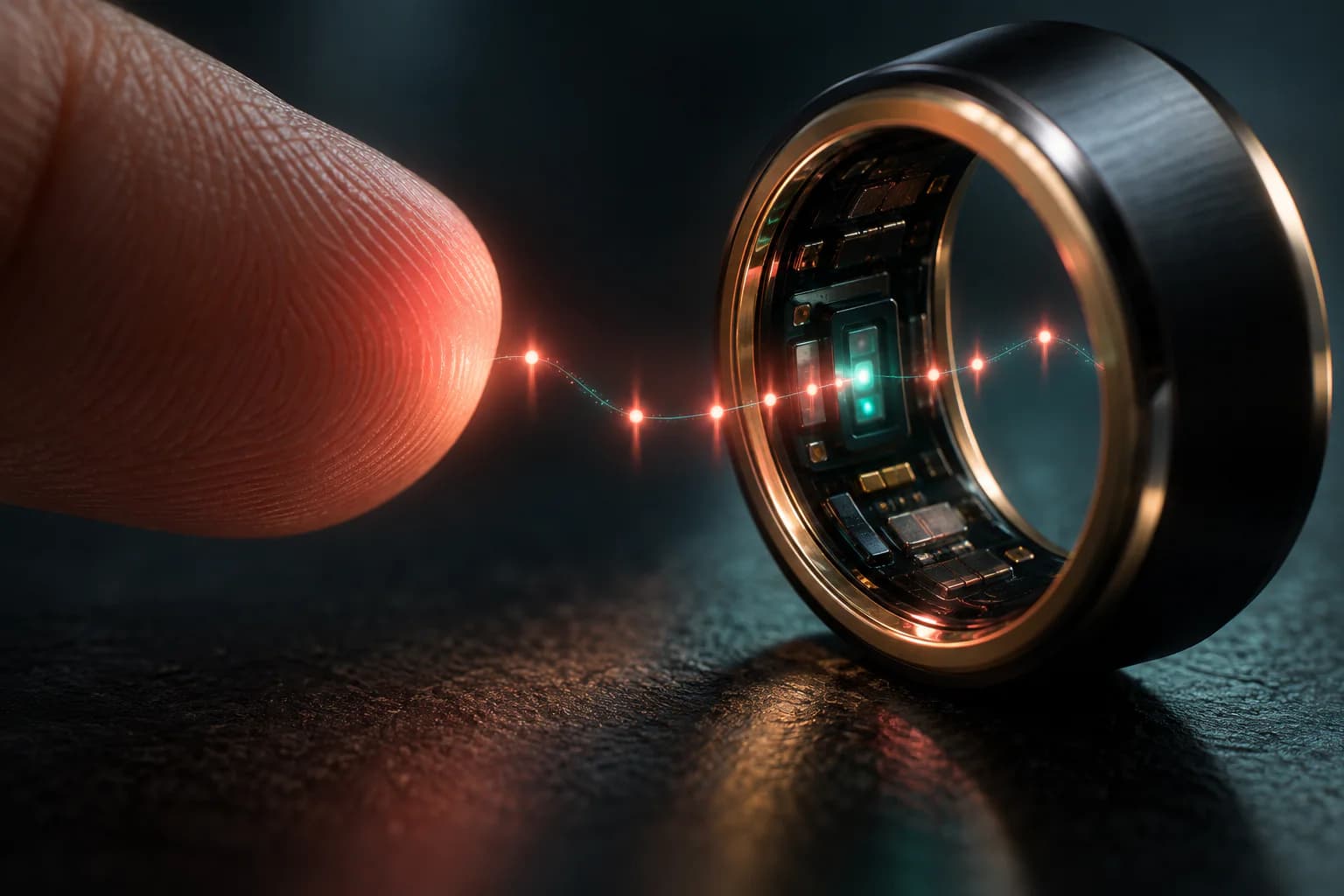
Short answer: Heart rate variability, or HRV, is the variation in time between consecutive heartbeats. A smart ring usually estimates HRV from optical pulse signals collected at the finger, often during sleep when movement is low. HRV can add context about recovery and autonomic regulation, but one number cannot diagnose stress, illness, overtraining, or heart disease.
If your heart rate is 60 beats per minute, you might imagine one beat arriving exactly every second. A healthy heart does not normally behave like a metronome.
One interval might be 0.96 seconds, the next 1.04 seconds, and the next 0.99 seconds. Those small timing changes are the raw material behind heart rate variability.
That is also why HRV is easy to misunderstand. It is not simply a faster or slower heart rate. It is not the same as feeling an irregular heartbeat. And it is not a universal score where every person should aim for the same number.
The most useful way to read HRV on an EnergyMo SmartRing is to compare measurements collected under similar conditions and ask what has changed from your own usual pattern.
What Does HRV Mean?
HRV describes variation in the interval between successive heartbeats. In an electrocardiogram, these intervals are commonly measured between the R waves of consecutive normal beats and are called RR or NN intervals. HRV calculations summarize how those intervals change over time.
The heart’s timing is influenced by the autonomic nervous system, which continuously adjusts body functions without conscious effort.
- The sympathetic branch helps mobilize the body for demand—the familiar “fight or flight” response.
- The parasympathetic branch supports rest, digestion, and recovery—the “rest and digest” response.
HRV reflects the combined output of a complex system. Breathing, sleep, activity, posture, temperature, emotions, medication, illness, age, fitness, and many other factors can influence it.
It is therefore too simplistic to label sympathetic activity “bad” and parasympathetic activity “good.” Both are necessary. The body needs to respond to demand and recover afterward.
Heart Rate vs HRV: What Is the Difference?
| Metric | What it describes | Example question |
|---|---|---|
| Heart rate | How many times the heart beats per minute | “Is my pulse 55 or 75 bpm?” |
| HRV | How much the time between normal beats varies | “How variable are the beat-to-beat intervals?” |
Two people can have the same average heart rate and very different HRV. The same person can also have a similar resting heart rate on two nights while HRV changes.
This is one reason HRV may add context beyond heart rate alone—but it should still be interpreted alongside sleep, activity, symptoms, and other information.
How Does a Smart Ring Measure HRV?
Most consumer smart rings do not record a continuous clinical ECG. They typically use photoplethysmography, or PPG.
Step 1: Light enters the skin
LEDs emit light into the finger. Blood volume changes with each pulse, altering the amount of light absorbed and reflected.
Step 2: The sensor records a pulse waveform
A photodetector captures the changing optical signal. Each usable pulse creates a feature in the waveform.
Step 3: The algorithm identifies pulse-to-pulse intervals
Software estimates the time between successive pulse-wave features. These are more precisely called pulse-to-pulse intervals, not ECG RR intervals.
Step 4: Noise and artifacts are filtered
Movement, loose fit, poor circulation, cold fingers, external pressure, missing pulses, and irregular rhythms can distort the waveform. Algorithms attempt to identify and remove unreliable segments.
Step 5: HRV metrics are calculated
Many wearables emphasize RMSSD, a time-domain HRV metric that is commonly used for short, resting measurements and is sensitive to rapid beat-to-beat variation associated largely with parasympathetic modulation.
The app may then display a nightly value, a trend, or a recovery-related interpretation.
Is Smart Ring HRV the Same as ECG HRV?
Not exactly.
ECG measures the heart’s electrical activity and identifies R-wave timing. PPG measures the peripheral pulse wave after blood leaves the heart and travels to the finger. The resulting quantity is sometimes called pulse rate variability (PRV).
Under quiet, stable conditions, PRV and ECG-derived HRV can agree closely for some metrics and devices. But they are not physiologically identical in every situation. Pulse transit, vascular tone, movement, temperature, breathing, irregular beats, and signal processing can introduce differences.
Published validation of one ring, firmware version, algorithm, population, or metric cannot automatically be transferred to every other smart ring.
For wellness use, the practical question is not whether a ring reproduces every laboratory HRV method. It is whether the exact device can produce repeatable, useful measurements under clearly defined conditions.
Why Do Smart Rings Often Measure HRV During Sleep?
Nighttime offers a relatively controlled measurement window:
- The body is usually still for longer periods.
- There are fewer hand movements than during daytime activity.
- Posture changes less frequently.
- Measurements can be repeated under broadly similar conditions each night.
- Longer quiet segments may be available for artifact filtering.
This can improve signal quality and make night-to-night comparisons more meaningful.
However, sleep is not a perfectly controlled laboratory. Awakenings, movement, room temperature, sleep stage, alcohol, illness, breathing disturbances, and bedtime changes can still affect the result.
What Is RMSSD?
RMSSD stands for root mean square of successive differences. It summarizes the differences between consecutive normal beat intervals.
In simplified form:
- Calculate the difference between each pair of consecutive normal intervals.
- Square each difference.
- Average those squared differences.
- Take the square root.
The result is usually reported in milliseconds.
You do not need to perform this calculation yourself. What matters is recognizing that RMSSD is one specific HRV metric. Other metrics—such as SDNN, frequency-domain measures, and nonlinear measures—are calculated differently and are not interchangeable.
Comparing an RMSSD value from one app with a differently defined “HRV score” from another can be misleading.
What Is a Good HRV?
There is no single “good HRV” number for everyone.
HRV varies with:
- Age.
- Genetics and individual physiology.
- Fitness and training history.
- Measurement duration.
- Time of day.
- Body position.
- Breathing pattern.
- Device and algorithm.
- HRV metric used.
- Medication and health conditions.
A value that is typical for one healthy person may be unusual for another. Even reference ranges from research depend on the population and protocol.
Instead of asking, “Is 40 ms good?”, ask:
- Is this measurement based on the same metric as my previous nights?
- Was it collected under similar conditions?
- Is it within my own stable long-term range?
- Is the change isolated or repeated?
- Do sleep, resting heart rate, activity, symptoms, or recent events provide context?
Is Higher HRV Always Better?
No.
In many resting and recovery contexts, a higher value relative to a person’s usual range may coincide with stronger parasympathetic modulation and better recovery. But “higher is always better” is not a safe rule.
An unusually high value may result from:
- Signal artifacts.
- Poor pulse detection.
- Ectopic or irregular beats.
- Differences in the calculation window.
- A change in device, finger, firmware, or algorithm.
- Normal individual variation.
HRV is meaningful only when the signal is valid and the context is understood.
Why Might HRV Be Lower Than Usual?
A lower night does not automatically mean something is wrong. It may coincide with one or several factors:
| Possible factor | Why it may matter |
|---|---|
| Short or disrupted sleep | Recovery-related autonomic patterns may differ |
| Alcohol | Can increase nighttime heart rate and reduce HRV in many people |
| Hard training | Acute load may temporarily alter HRV |
| Psychological stress | Autonomic demand may change |
| Illness or inflammation | The body may be responding to physiological stress |
| Dehydration | Can affect cardiovascular responses |
| Travel or jet lag | Sleep timing and circadian rhythm may shift |
| Heat | Thermoregulation changes cardiovascular demand |
| Medication or substances | Some drugs, nicotine, stimulants, and other substances affect heart timing |
| Menstrual-cycle and hormonal changes | HRV patterns may change across individuals and phases |
| Measurement quality | Fit, motion, cold fingers, pressure, or a poor optical signal may distort results |
This list is not diagnostic. The same HRV change can have different explanations in different people.
Can HRV Tell You Whether You Are Stressed?
HRV can add context about autonomic regulation, but it is not a direct stress meter.
Psychological stress may reduce HRV in some situations, but so can exercise, poor sleep, alcohol, illness, heat, travel, or medication. A lower value cannot tell you which cause is responsible.
Likewise, feeling stressed does not guarantee a particular HRV pattern. Subjective experience and wearable measurements describe different parts of the picture.
A better interpretation is:
“My HRV has been below its usual range for several nights, and my sleep, workload, and perceived stress have also changed.”
That statement keeps the data connected to context without turning it into a diagnosis.
Can HRV Measure Recovery From Exercise?
HRV can contribute to a recovery conversation, especially when measured consistently at rest. But it should not be the only factor used to decide whether to train.
Consider HRV alongside:
- Sleep quantity and continuity.
- Resting heart rate.
- Muscle soreness.
- Mood and motivation.
- Recent training load.
- Performance during warm-up.
- Illness symptoms.
- The demands of the planned session.
Research on HRV-guided training is promising in some settings, but responses vary and evidence about overreaching or overtraining is not perfectly consistent.
One low value does not automatically require a rest day. One high value does not guarantee readiness for maximal exercise.
How Accurate Is Smart Ring HRV?
The honest answer is: it depends on the exact ring, metric, conditions, and user.
Some ring studies have reported good agreement with ECG for nocturnal heart rate and RMSSD in studied participants. Other research warns that PPG-based HRV can become less reliable when motion, vascular changes, irregular rhythms, or signal-processing differences are present.
Accuracy should be evaluated at several levels:
- Sensor validity: Does the ring record a clean pulse signal?
- Interval detection: Does it identify pulse timing correctly?
- Artifact handling: Does it exclude unreliable segments appropriately?
- Metric calculation: Does the app use a clearly defined HRV method?
- Interpretation validity: Does a recovery or stress score mean what the app claims?
A device can estimate pulse intervals well and still overstate what a downstream wellness score can conclude.
What Can Make Smart Ring HRV Less Reliable?
- A loose ring that shifts during sleep.
- A ring that is painfully tight or under external pressure.
- Cold hands or reduced peripheral circulation.
- Movement and repeated awakenings.
- Sleeping on the hand in a way that affects contact.
- Dirty or obstructed sensors.
- Tattoos, skin characteristics, or optical factors that affect the signal.
- Irregular beats or rhythm disturbances.
- Comparing different devices or fingers.
- Firmware or algorithm changes.
- Too little valid data during the night.
The app should ideally communicate missing or low-confidence data rather than filling every night with a precise-looking number.
How to Read Your EnergyMo HRV Trend
1. Keep the measurement conditions consistent
Wear the same ring on the same preferred finger, with stable sensor contact. Avoid changing devices, fingers, or settings during a comparison period when possible.
2. Build enough history
Do not define your normal pattern from two nights. Collect at least a couple of weeks under ordinary conditions, and continue refining your understanding over longer periods.
3. Look at the trend, not the ranking
Your goal is not to beat another person’s HRV. Look for repeated movement outside your own stable range and how quickly it returns.
4. Add four pieces of context
For an unusual night, note:
- Sleep and bedtime.
- Training and activity load.
- Alcohol, illness, travel, medication, or unusual heat.
- How you actually feel.
5. Check related signals
An HRV change is easier to interpret when you also review resting heart rate, sleep continuity, temperature trend, activity, and symptoms. A coordinated change across several measures may be more informative than one isolated number, but it still does not diagnose a condition.
6. Use small, reversible actions
If several indicators suggest higher load, consider an earlier night, hydration, a lighter workout, or a calmer day when appropriate. Then observe whether the pattern changes.
7. Escalate symptoms, not just scores
Seek professional advice for concerning symptoms or persistent unexplained changes. Do not wait for a wearable threshold to tell you whether chest pain, fainting, severe shortness of breath, or another urgent symptom matters.
A Simple 14-Night HRV Experiment
This experiment is designed to improve interpretation—not maximize the number.
Nights 1–7: Observe without optimizing
Keep your routine reasonably normal. Record bedtime, alcohol, late exercise, perceived stress, illness, and any major schedule changes.
Nights 8–14: Change one factor
Choose one realistic action:
- Keep bedtime within a consistent window.
- Move caffeine earlier.
- Avoid alcohol.
- Replace a late intense workout with a lighter session.
- Add a brief slow-breathing or relaxation routine.
At the end, ask:
- Did HRV move consistently or only once?
- Did sleep and resting heart rate change in the same direction?
- Did I feel different?
- Were measurement conditions comparable?
- Is the change large enough and repeatable enough to matter to my behavior?
This cannot prove causation, but it can help turn passive data into a better personal question.
Can HRV Predict a Heart Attack?
No consumer smart-ring HRV value can reliably predict that an individual heart attack is about to occur.
HRV has been studied in many clinical populations and research contexts, but a wellness-ring trend is not a heart-attack detector. Low HRV is nonspecific and can occur for many reasons; normal or high HRV does not rule out cardiovascular disease.
Do not use HRV to delay care. Seek emergency help for symptoms such as chest pressure or pain, fainting, severe shortness of breath, sudden weakness, or other signs of a medical emergency according to local guidance.
Can HRV Detect an Irregular Heart Rhythm?
HRV and rhythm detection are different tasks.
An irregular rhythm may alter pulse intervals and make an HRV value look unusually high or unstable. But an HRV number cannot identify the rhythm or replace an ECG.
If you notice palpitations, fainting, chest discomfort, severe breathlessness, or repeated abnormal pulse alerts, discuss them with a healthcare professional. EnergyMo HRV should not be described as diagnosing atrial fibrillation or another arrhythmia unless an exact feature has specific regulatory authorization for that intended use.
EnergyMo SmartRing and HRV
EnergyMo’s current feature page describes HRV tracking as a way to view recovery, resilience, and autonomic trends. The product uses finger-based optical sensors and is designed for day-and-night wellness tracking.
Its responsible role is to help users:
- Observe nightly HRV under relatively stable conditions.
- Compare trends with sleep, resting heart rate, activity, temperature, and energy-related insights.
- Notice repeated changes from their own usual range.
- Form better questions about recovery and daily habits.
EnergyMo HRV should not be presented as a diagnosis of stress, infection, overtraining, arrhythmia, heart attack risk, or autonomic disease.
Frequently Asked Questions
What is HRV in simple terms?
HRV is the small variation in time between consecutive normal heartbeats. It reflects changing regulation of the heart by the body’s autonomic and related physiological systems.
Is HRV the same as heart rate?
No. Heart rate counts beats per minute. HRV describes variation in the timing between those beats.
How does a smart ring measure HRV?
It usually uses PPG light sensors to detect pulse waves at the finger, estimates pulse-to-pulse intervals, filters unreliable segments, and calculates a metric such as RMSSD.
What is a good HRV for my age?
There is no universal target. Age matters, but so do physiology, fitness, medication, health, measurement duration, time, posture, device, and metric. Consistent comparison with your own stable range is usually more useful than a generic chart.
Why is my HRV lower after drinking alcohol?
Alcohol can alter sleep, raise nighttime heart rate, and reduce HRV in many people. The response varies with amount, timing, individual physiology, and other conditions.
Why did my HRV drop even though I feel fine?
Normal variation, measurement quality, training, sleep, heat, travel, medication, hydration, hormones, or an early physiological response may contribute. One value rarely identifies the cause.
Is higher HRV always healthier?
No. A higher value within your usual, valid pattern can be encouraging in some contexts, but artifacts and irregular beats can also inflate HRV. Context and signal quality matter.
Can HRV diagnose anxiety or stress?
No. HRV can add information about autonomic regulation, but it cannot diagnose psychological stress, anxiety, or their cause.
Can HRV warn me before a heart attack?
No. Consumer HRV is not a heart-attack prediction tool. Seek urgent care based on concerning symptoms, not a wearable score.
The Bottom Line
HRV is not a score of how healthy, calm, or fit you are. It is a measurement of beat-to-beat timing variation that becomes useful only when the method, conditions, signal quality, and context are understood.
A smart ring can make HRV easier to observe repeatedly because the finger offers an optical measurement site and sleep provides longer low-movement periods. But PPG-derived pulse variability is not identical to clinical ECG HRV in every situation.
Use EnergyMo HRV to compare your own nights, connect repeated changes with sleep and daily habits, and test small adjustments. Do not use one high or low value to diagnose illness, approve maximal training, or dismiss symptoms.
Health notice: EnergyMo SmartRing is a consumer wellness device, not a medical device. HRV and related scores are not intended to diagnose, treat, cure, prevent, or predict disease. Seek qualified medical care for symptoms or concerns.
Research Sources
- Task Force of the European Society of Cardiology and the North American Society of Pacing and Electrophysiology. Heart Rate Variability: Standards of Measurement, Physiological Interpretation and Clinical Use
- Li K, et al. Heart Rate Variability Measurement through a Smart Wearable Device: Another Breakthrough for Personal Health Monitoring?
- Cao R, et al. Accuracy Assessment of Oura Ring Nocturnal Heart Rate and Heart Rate Variability
- Kantrowitz AB, et al. Pulse Rate Variability Is Not the Same as Heart Rate Variability
- Sammito S, et al. Update: Factors Influencing Heart Rate Variability—A Narrative Review
- Damoun N, et al. Heart Rate Variability Measurement and Influencing Factors
Continue Exploring
EnergyMo products are consumer wellness devices, not medical devices. They are not intended to diagnose, treat, cure, or prevent any disease. Information provided is not medical advice.
Track what your body is telling you
EnergyMo Ring brings sleep, recovery, and daily movement into one discreet wearable.