

Not necessarily.
HRV describes the variation in timing between heartbeats. It can shift with age, fitness, sleep, stress, alcohol, training load, and how your body is feeling.
That is why HRV is not a competition.
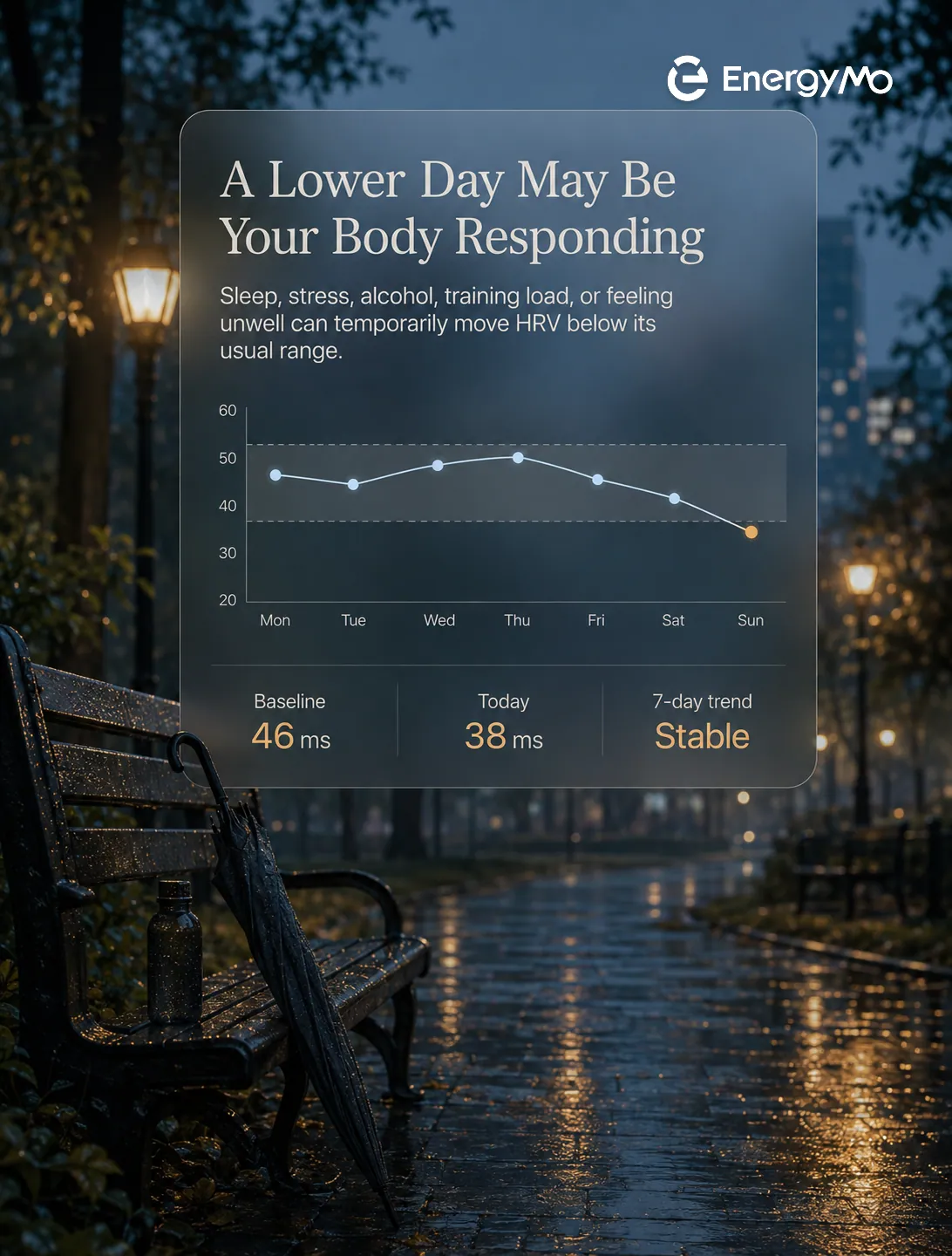
Someone else having a higher number does not automatically mean they are healthier. A lower reading today does not automatically mean something is wrong. The more useful comparison is with your own baseline and the pattern developing across several days.
When HRV is lower than usual, consider the context:
Was your sleep disrupted?
Has stress been higher recently?
Was yesterday’s training unusually demanding?
Could alcohol, fatigue, or feeling unwell be contributing?
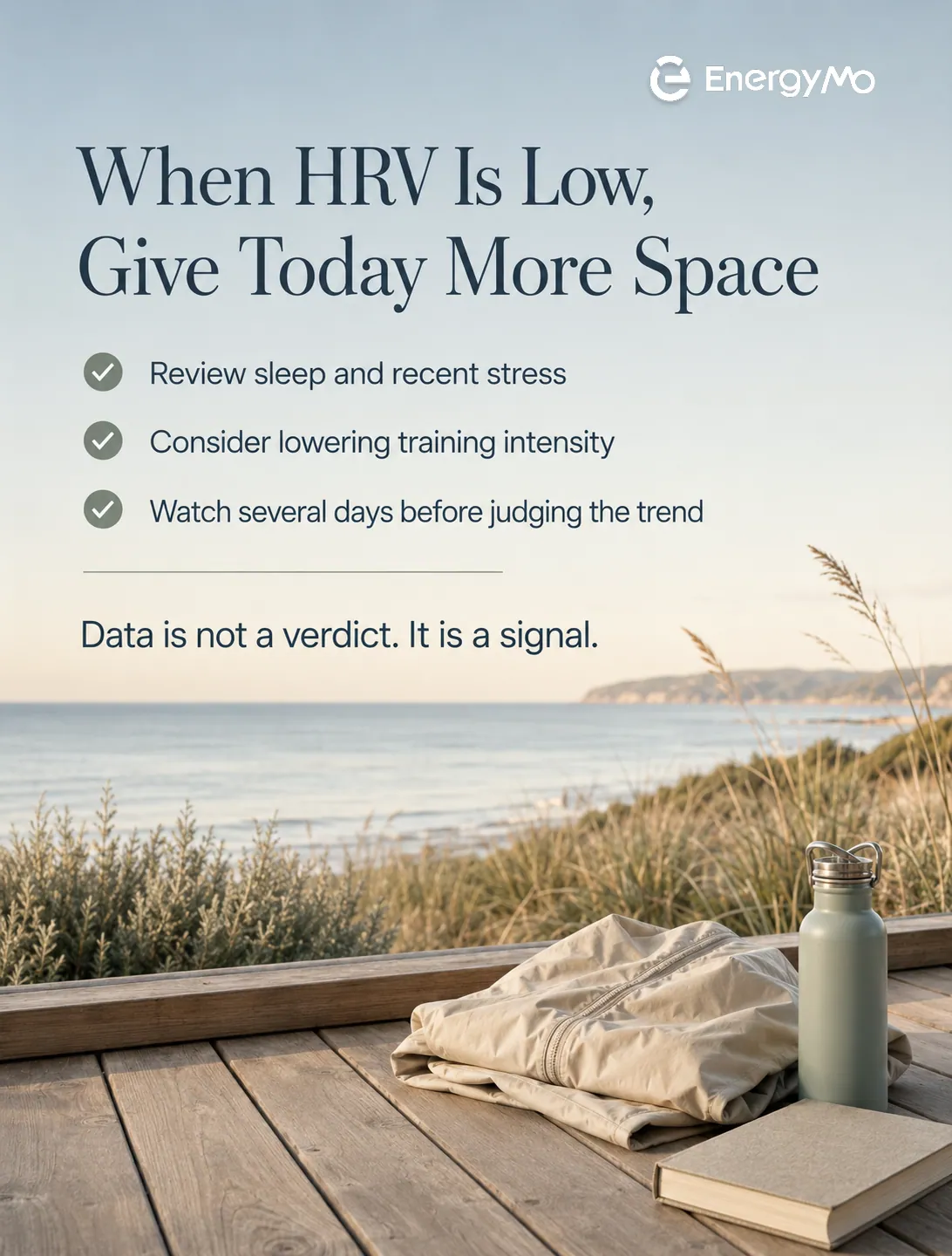
You might give the day more space, lower training intensity, and continue watching the trend before drawing conclusions.
One day can fluctuate. A repeated pattern tells a more useful story.
Data is not a verdict. It is a signal.
Does your HRV usually change after a poor night of sleep?
Continue with the complete guide
First decide whether the drop is real
A low-looking value can come from the body, the measurement, or both. Before explaining it, compare the night with your normal measurement conditions.
- Was the ring in its usual position and comfortably snug?
- Are large parts of the night missing?
- Were your hands unusually cold?
- Did you change devices, fingers, firmware or sleep schedule?
- Is the app showing the same metric and unit as before?
If the signal is incomplete, the most honest conclusion may be “insufficient evidence.” Rewearing the ring correctly tonight is more useful than inventing a physiological story from weak data.
One low night and a downward pattern are different questions
Suppose your recent values are 48, 51, 47, 50, 34 ms. The final value is conspicuous, but it is still one observation. Now compare 48, 44, 40, 36, 34 ms: the latest number is similar, while the pattern is different.
A rolling median can make a personal trend easier to see because it is less sensitive to one extreme night. Also look at variability around the baseline. A stable average with increasingly scattered readings may deserve attention even before the average moves.
Build a context timeline, not a list of guesses
| Time window | Useful questions |
|---|---|
| Previous afternoon | Hard or unfamiliar training? Long travel? Heat exposure? |
| Evening | Alcohol? Late heavy meal? Unusual caffeine? Emotional strain? |
| Night | Short sleep opportunity? Repeated awakenings? Unusual bedtime? |
| Morning | Sore throat, feverish feeling, fatigue, dizziness or other symptoms? |
| Recent week | Accumulated training, work pressure, medication change or jet lag? |
None of these proves causation. The timeline helps you find repeated associations. If the same behavior is repeatedly followed by a similar change, you have a more useful personal observation than a generic internet explanation.
Read HRV beside other evidence
| Pattern | Proportionate response |
|---|---|
| Low HRV, normal resting heart rate, feel well | Keep the day flexible; recheck the trend |
| Low HRV plus higher resting heart rate and poor sleep | Consider reducing optional intensity and prioritize recovery basics |
| Low HRV plus illness symptoms | Treat symptoms seriously; wearable data cannot identify the illness |
| Low HRV after a clearly harder session | Compare with previous sessions and allow for the training dose |
| Low HRV with missing/noisy data | Fix measurement conditions before interpretation |
This is not a traffic-light diagnosis. It is a way to avoid letting one score make the entire decision.
What to do today
Start with low-risk actions: keep hydration and meals regular, protect tonight’s sleep opportunity, and avoid adding unnecessary training load if you also feel under-recovered. A gentle walk can be reasonable when you otherwise feel well; a wearable score alone does not require bed rest.
Do not change prescribed medication or attempt to “hack” HRV with supplements because of one reading. If a meaningful change persists, record the dates, symptoms, sleep and recent activity so a qualified professional has useful context.
Frequently Asked Questions
How much of a drop counts as significant?
There is no universal percentage. Devices calculate and summarize HRV differently, and normal day-to-day variation differs between people. Use the range and variability established by the same device over time.
Can low HRV predict that I am getting sick?
HRV can change around illness, but it is nonspecific and cannot confirm an infection or predict exactly what will happen. Symptoms and appropriate medical testing matter more.
Should I cancel a workout because HRV is low?
Not automatically. Consider signal quality, the size and duration of the change, resting heart rate, sleep, symptoms, recent load and how the warm-up feels. A modified session can be more appropriate than an all-or-nothing rule.
Sources and Further Reading
- Monitoring training adaptation and recovery using HRV
- Consumer wearable technology in cardiovascular medicine
- HRV standards of measurement and interpretation
Continue Exploring
This article is general wellness education, not a diagnosis or individualized training prescription.