

Before reacting to one number, check the context.
Resting heart rate varies with age, fitness, lifestyle, and your individual physiology. That means there isn’t one “perfect” number for everyone. The more useful starting point is your own baseline—the range that feels normal for you over time.
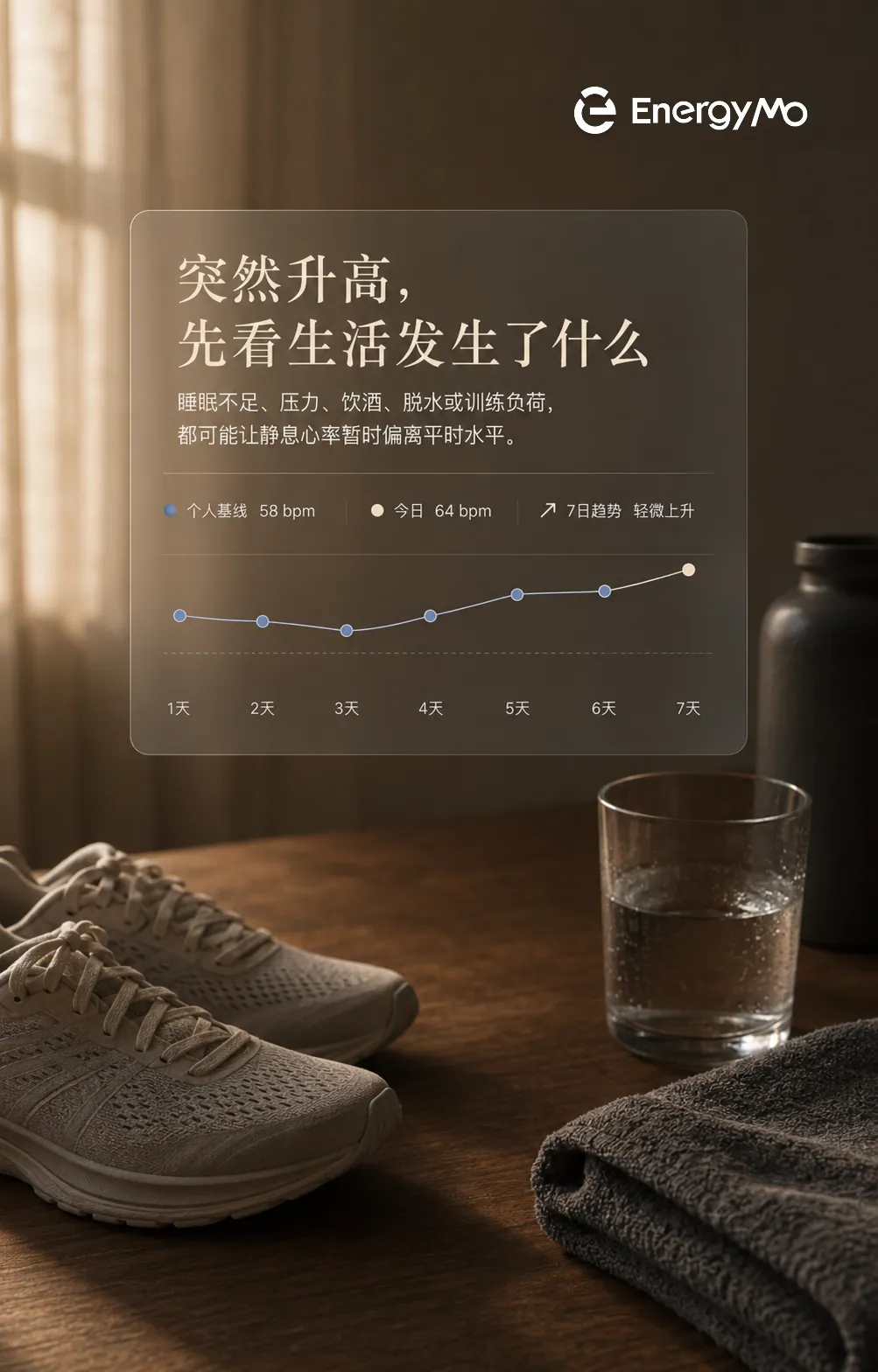
Poor sleep, stress, alcohol, dehydration, or a heavier training load can temporarily move your resting heart rate away from its usual range.
For a more meaningful view

Check your data under similar conditions
Compare trends across seven days or more
Connect changes with sleep, stress, recovery, and training
A single rise doesn’t always mean something is wrong. What matters more is whether the change continues and how it relates to the rest of your data.
One number is a moment. The trend is the clue.
When does your resting heart rate usually change?
Continue with the complete guide
Make sure it is really a resting comparison
“Resting heart rate” is not simply any heart-rate value captured while you were not exercising. A reading after walking upstairs, during a stressful meeting, after caffeine, or immediately after standing reflects different conditions. Nighttime summaries can also differ by device: one app may use a selected low-motion window, another a nightly average.
Compare like with like:
- use the same device and finger;
- compare the same app metric and time window;
- check whether the night contains gaps or obvious motion;
- note bedtime, wake time and sleep duration;
- avoid comparing a seated manual reading directly with a proprietary nightly score.
Why one morning may be higher
Heart rate changes to meet the body’s demands. A modest one-day rise can follow shorter or fragmented sleep, alcohol, dehydration, heat, emotional strain, a late heavy meal, hard training, travel, fever, pain, some medications, nicotine or more caffeine than usual. The list is not a diagnosis. Several factors can overlap, and the ring cannot tell which one caused the change.
Pattern matters more than a universal cutoff
| Pattern | What it may justify |
|---|---|
| One higher night, feel normal | Check measurement quality and observe the next nights |
| Higher for several nights after travel or hard training | Protect sleep and reduce avoidable load while the baseline settles |
| Higher heart rate plus lower HRV and disrupted sleep | Treat the cluster as stronger evidence of strain than any single value |
| Higher value plus feverishness or other illness symptoms | Respond to symptoms; wearable data cannot identify the condition |
| Recurrent fast rate or palpitations at rest | Record timing and symptoms and seek clinical advice |
A personal baseline is useful because resting rates differ with age, fitness, medication and physiology. It is not a medical clearance. A persistent shift deserves more attention than a single peak, especially if it is accompanied by symptoms or a meaningful change from your established pattern.
A three-minute review before changing your day
- Validate: Was the signal complete and collected under usual conditions?
- Contextualize: What changed in sleep, training, alcohol, hydration, heat, stress, travel or medication?
- Corroborate: Did HRV, temperature, sleep continuity or your own symptoms change too?
- Respond proportionately: Protect recovery basics and avoid unnecessary intensity when several signs agree.
- Reassess: See whether the value returns toward your usual range rather than trying to force it down immediately.
Do not change prescribed medication because of a wearable reading. Seek urgent medical help for a fast or pounding heartbeat with chest pain, severe shortness of breath, fainting or near-fainting. Recurrent or prolonged palpitations also deserve professional assessment even if the wearable score looks normal.
Frequently Asked Questions
Is a lower resting heart rate always healthier?
No. Fitness can lower resting rate, but medication, conduction problems and other conditions can also affect it. Context and symptoms matter.
Can poor sleep raise resting heart rate?
It can be associated with a higher overnight or morning rate, but one night cannot prove that sleep was the cause. Look for a repeated pattern under comparable conditions.
Why is the ring different from a manual pulse count?
They may cover different time windows and use different processing. A ring may summarize selected nighttime data; a manual count describes the moment you measured it.
Sources and Further Reading
- JACC: consumer wearable health and fitness technology
- NHS: heart palpitations, causes and urgent warning signs
- Review of individual heart-rate responses and wearable measurement
Continue Exploring
This article provides general wellness education and does not diagnose a heart-rhythm or other medical condition.
EnergyMo products are consumer wellness devices, not medical devices. They are not intended to diagnose, treat, cure, or prevent any disease. Information provided is not medical advice.
Track what your body is telling you
EnergyMo Ring brings sleep, recovery, and daily movement into one discreet wearable.