

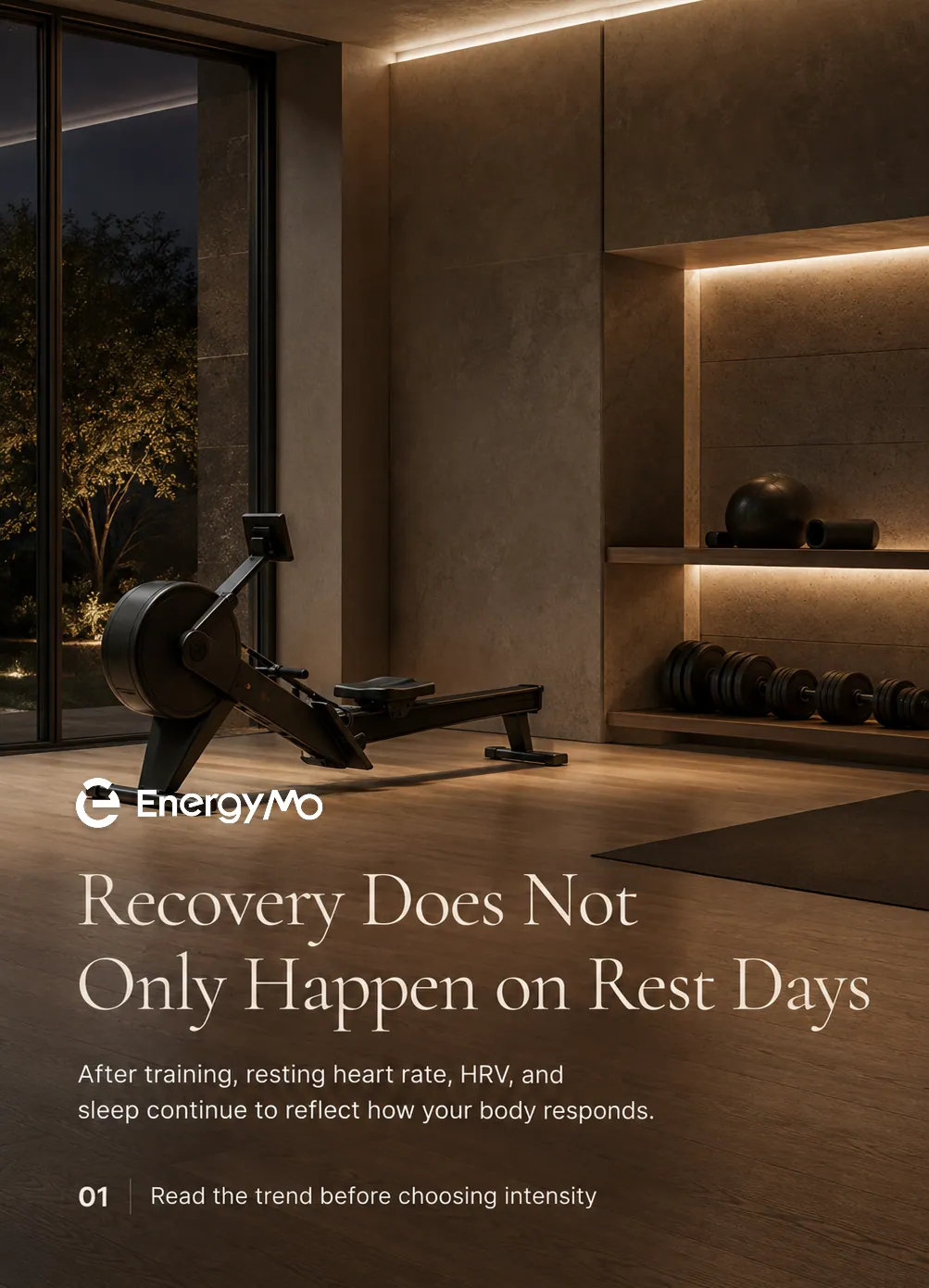
Your training session may be over, but your body is still responding to the load. What happens afterward can be just as meaningful as the workout itself.
A Smart Ring can help you follow several personal recovery trends:
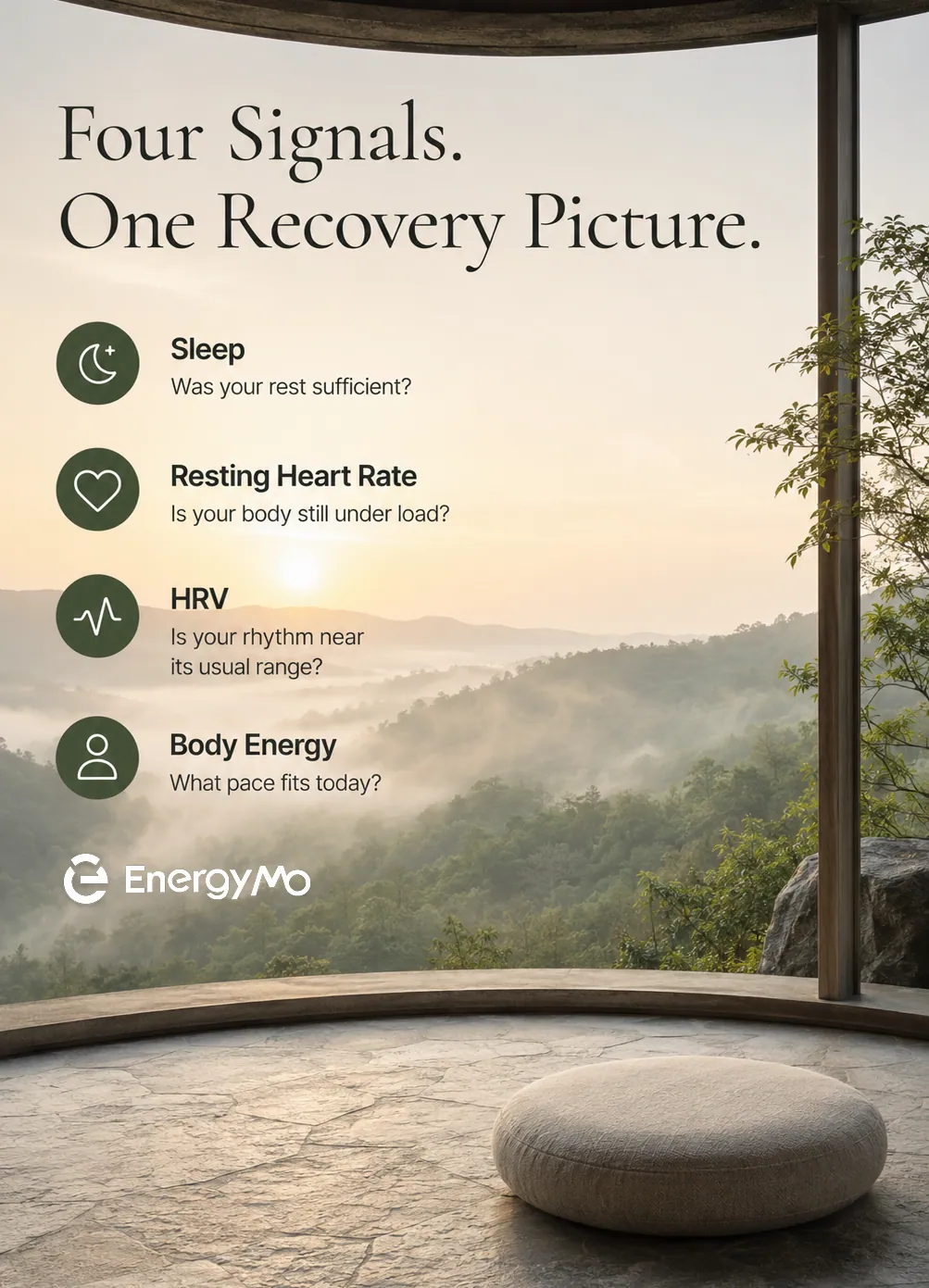
- Sleep: Did you get enough restorative rest?
Resting heart rate: Is your body still carrying extra load?
HRV: Is your recovery rhythm close to its usual range?
Body Energy: Does today call for more—or less?
One isolated number should not decide your training plan.
If sleep was limited, resting heart rate remains above your normal range, or HRV continues to shift away from your baseline, a lighter day may be appropriate. Walking, mobility work, yoga, or an easy swim can still support an active lifestyle while giving your body room to recover.
Three simple steps for tonight
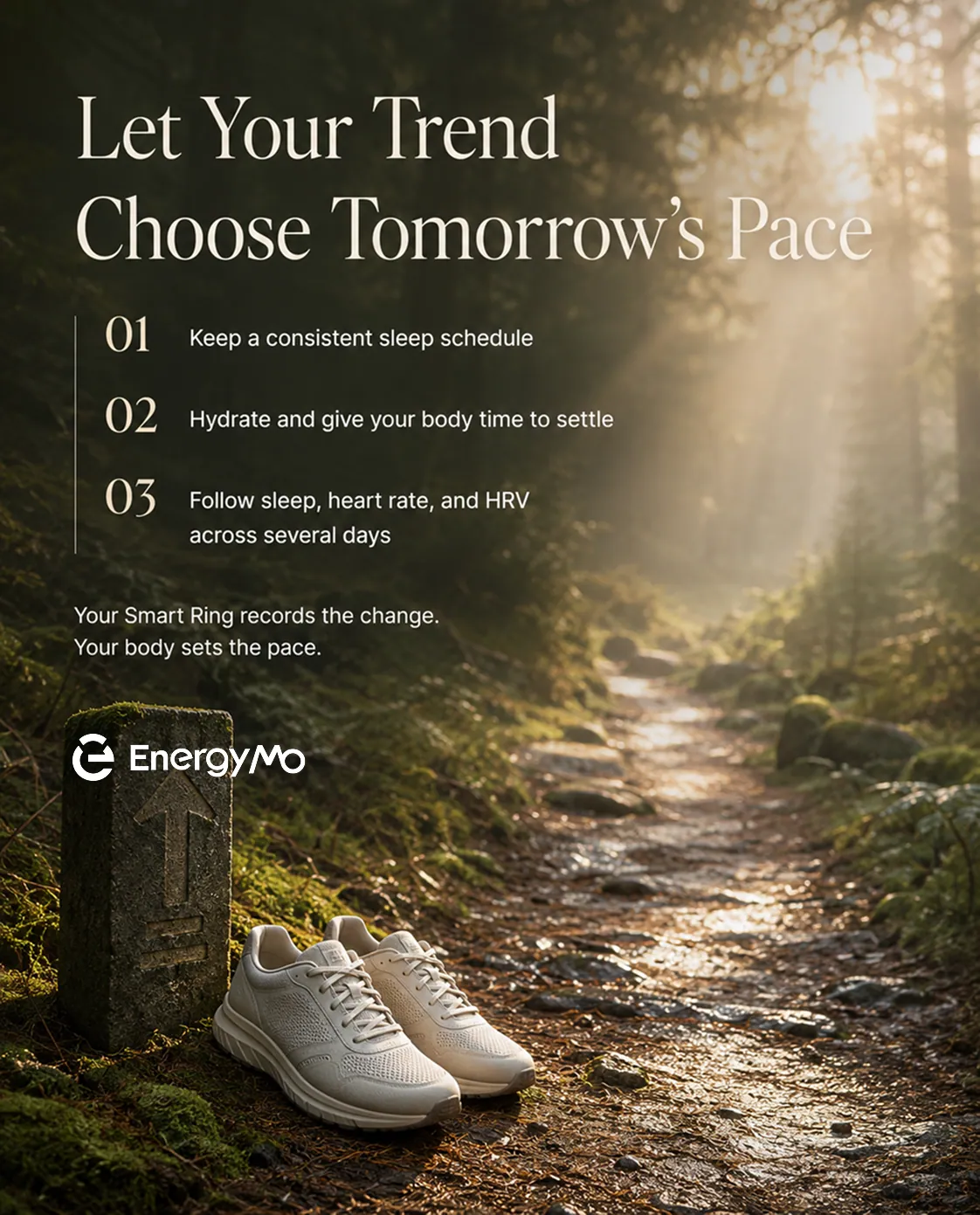
Keep a consistent sleep schedule
Hydrate and allow your body time to settle
Follow sleep, heart rate, HRV, and Body Energy across several days
EnergyMo Smart Ring records the change. Your body sets the pace.
Smart Ring insights are intended for personal wellness and fitness-trend reference and do not replace professional medical assessment.
#SmartRing #EnergyMo #WorkoutRecovery #RecoveryTracking #SleepTracking #HeartRateMonitoring #RestingHeartRate #HRVTracking #BodyEnergy #FitnessWearable
Continue with the complete guide
Recovery is not one process with one finish time
The session ends when you stop moving; its effects do not. Heart rate, autonomic regulation, body temperature, fluid balance, fuel availability, muscle function and perceived fatigue recover on different timelines. A normal heart rate five minutes after exercise does not prove that every system is ready for another hard session.
Exercise dose matters. Intensity is a major influence on post-exercise autonomic recovery, while duration, modality, heat, hydration and training experience also change the response. Resistance training, intervals and long endurance work should not be expected to produce identical overnight patterns.
What a ring can add after training
| Signal | Useful question | Important limit |
|---|---|---|
| Nighttime heart rate | Is it elevated relative to comparable nights? | Cannot identify the cause |
| HRV trend | Has the personal pattern shifted after this load? | PPG-derived values are sensitive to signal conditions |
| Sleep continuity | Did the session or its timing disturb sleep? | Sleep staging is an estimate |
| Temperature trend | Is there a sustained deviation from personal baseline? | Heat, environment and illness can overlap |
| Activity history | Was this an isolated workout or accumulated load? | External load does not equal internal strain |
The ring does not measure muscle glycogen, microscopic muscle damage, tendon readiness or motivation directly. Keep soreness, pain, appetite, mood and actual performance in the decision.
Compare the workout with its own context
Record four facts: the type of session, duration, perceived effort and finish time. Then note unusual conditions such as heat, altitude, poor hydration or a major increase from recent training. This creates a repeatable comparison. “Hard workout” is too vague; “45 minutes of intervals finished three hours before bed” is useful.
A next-day decision framework
- Green-light pattern: normal trend, good sleep, ordinary soreness and a normal warm-up. Proceed as planned, while still adjusting to how the session feels.
- Mixed pattern: one metric is unusual but you otherwise feel normal. Keep options open; use an easier warm-up and reassess.
- Accumulated-strain pattern: several nights of higher resting heart rate, lower HRV, disrupted sleep and poor subjective recovery. Reduce optional intensity or volume.
- Pain or illness pattern: sharp pain, swelling, fever, chest symptoms, faintness or marked breathlessness is not a readiness-score problem. Stop and obtain appropriate care.
Do not use HRV alone to prescribe training. Research supports repeated, standardized measurements and rolling trends more than isolated numbers. Even then, the evidence is strongest as one input in an individualized monitoring process—not as an automatic command.
Frequently Asked Questions
How long should recovery take?
There is no single duration. It varies with training dose, fitness, sleep, nutrition, heat, illness and the tissue involved. Some autonomic measures may recover quickly while soreness or performance remains affected.
Why did I sleep worse after exercising?
Late timing, high intensity, heat, hydration, fueling and individual response can all matter. Compare similar sessions and finish times instead of concluding that all evening exercise is harmful.
Can a good recovery score mean I am ready for maximal training?
No score can verify every relevant system. Use the score with the training plan, symptoms, soreness and warm-up performance.
Sources and Further Reading
- Cardiac autonomic responses during exercise and recovery
- HRV monitoring of training adaptation and recovery
- Systematic review of HRV after resistance exercise
Continue Exploring
This article is general wellness education, not an individualized training or medical prescription.
EnergyMo products are consumer wellness devices, not medical devices. They are not intended to diagnose, treat, cure, or prevent any disease. Information provided is not medical advice.
Track what your body is telling you
EnergyMo Ring brings sleep, recovery, and daily movement into one discreet wearable.