
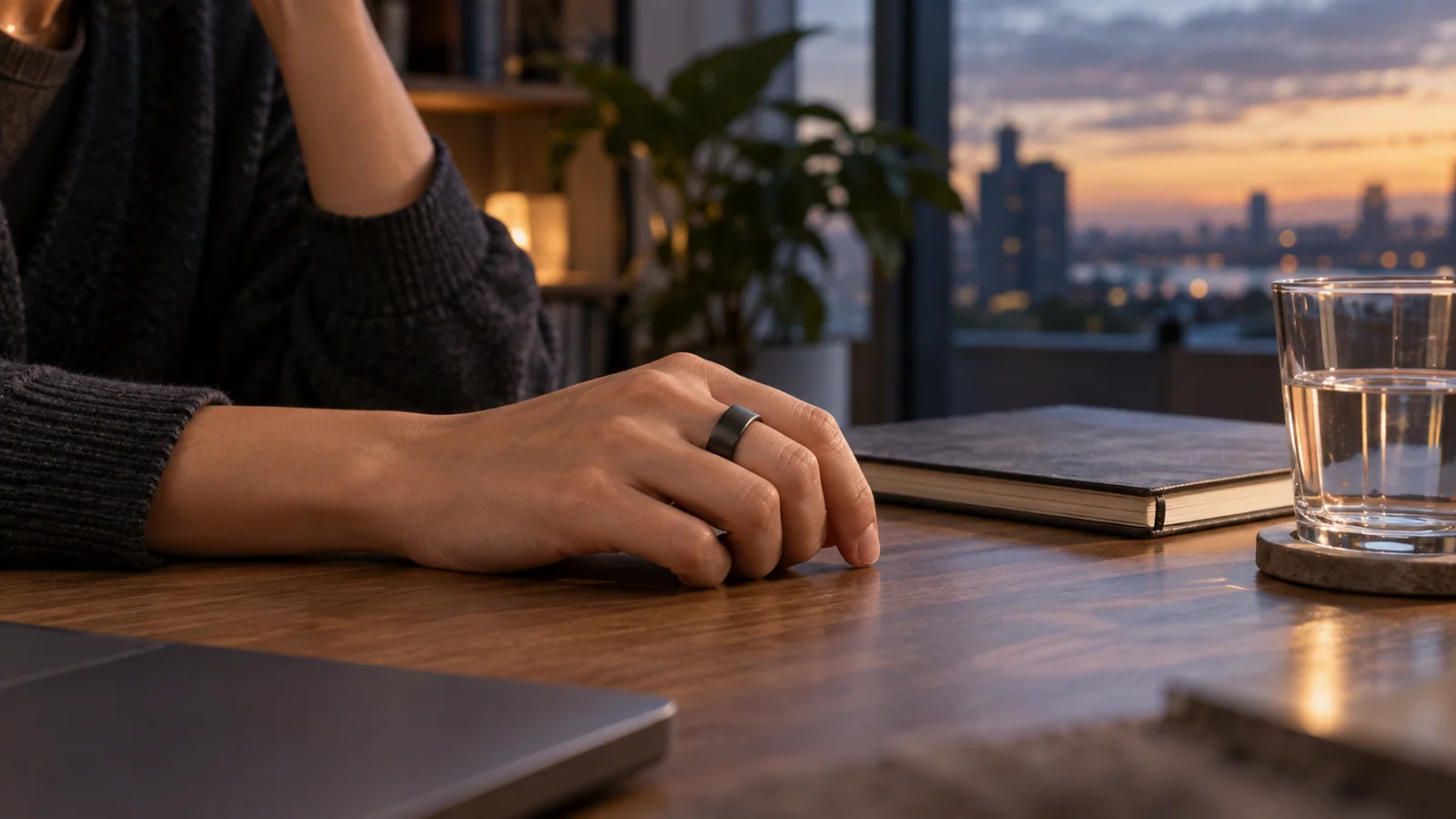
How Smart Rings Track Stress Without Reading Emotions
Short answer: Smart rings do not read thoughts or directly measure emotional stress. They use supported signals such as pulse rate, pulse-to-pulse timing and movement to estimate a physiological pattern. A stress score is the algorithm's interpretation of those signals, not a diagnosis or an explanation of why you feel the way you do.
You feel relaxed after dinner, but the app says "stressed." Or you feel overwhelmed at your desk while the chart looks calm. Neither situation is a reason to assume your feelings are wrong. The ring and your own experience are describing different things.
The useful question is not "Does the ring know I am stressed?" It is "What did it observe, what else could explain it, and does the pattern help me make a sensible decision?"
What a ring measures—and what it infers
| Layer | What it can contain | What it does not establish |
|---|---|---|
| Sensor recording | Reflected light, movement and, on supported models, skin temperature | A thought, emotion or psychological diagnosis |
| Derived measurements | Pulse rate and pulse-to-pulse intervals after signal processing | The exact cause of a change |
| Stress estimate | A model-specific category or score | A universal stress unit shared by all brands |
| Your interpretation | Context about work, exercise, illness and how you feel | Proof of cause from one coincidental event |
The distinction matters because a precise-looking number can hide several layers of inference. "Stress 70" is not comparable to 70 on another brand's scale, and it is not a cortisol measurement.
How signals become a stress estimate
1. Obtain a usable pulse signal
An optical sensor uses light to observe pulse-related changes at the finger. Software identifies usable pulse timing and rejects or handles noisy segments. Ring movement, a changing fit and cold hands can complicate that step.
A blank period may mean insufficient usable data rather than a period of complete relaxation. Check the recording before interpreting the score. Our fit guide explains why making a ring tighter is not a safe universal fix.
2. Calculate features, not emotions
The software can derive pulse rate, interval variability and changes over time. A movement sensor helps describe whether those changes occurred while still or active. Other supported signals may add context; not every ring has the same sensors or uses them in the same way.
PPG measures pulse-wave timing at the finger rather than the heart's electrical R–R intervals directly. Treat pulse-derived HRV-related values according to the device's method, not as interchangeable with every ECG or research measure. A higher average pulse can coexist with either higher or lower variability; one number does not determine the other.
3. Compare patterns using the product's rules
An algorithm may compare the features with a personal baseline, learned patterns or both. It then produces the categories displayed in the app. Some products restrict calculations during movement or need an initial calibration period. Check the current documentation rather than assuming that every minute receives the same analysis.
For a concrete example, Oura's Daytime Stress documentation describes a physiological response that may differ from perceived stress. That explains Oura's feature; it does not disclose EnergyMo's algorithm or validate its performance.
4. Add the context the sensor cannot supply
The ring does not automatically know whether a pulse change followed a presentation, a meal, a warm room or an exciting conversation. Your notes supply information that the sensor lacks. Even with context, an association remains a hypothesis unless the evidence supports a stronger conclusion.
Does low HRV always mean stress?
No. A single low value is not an emotional label, a diagnosis or a reason to chase the highest possible HRV.
First check whether you are comparing like with like: the same device, metric, measurement window, posture and approximate conditions. An overnight average and a short daytime measurement answer different questions. A firmware change or an altered recording window can also complicate comparison.
Then look for context. The original question—how you feel—still matters. If a chart contradicts your experience, retain both observations rather than making one erase the other. Do not use a population threshold from a different sensor or study as your personal alarm limit.
Why can a ring say I am stressed when I feel fine?
Treat this table as a set of possibilities to check, not diagnoses made from a graph.
| Situation | Useful question | What not to conclude |
|---|---|---|
| After exercise | Is the body still recovering, and was this period analyzed as rest or activity? | The workout caused emotional harm |
| After coffee, alcohol or a large meal | Is this a repeated association on comparable days? | One substance is proven to explain every change |
| During heat, illness or disrupted sleep | Are there other changes or symptoms worth noting? | A stress score identifies an illness |
| During quiet desk work | Is there sustained concentration, tension or a noisy recording? | The ring can identify your thoughts |
| During a happy social event | Could physiological activation coexist with a positive experience? | All activation is undesirable |
| When the ring shifts or the record has gaps | Does fit or synchronization need attention? | Every apparent spike is a real physiological event |
Likewise, a low score does not rule out distress. You do not need an abnormal wearable result to take persistent emotional difficulty seriously or seek support.
A practical way to review a high-stress period
- Check completeness. Confirm that the session recorded and synchronized. Note gaps and unusually loose contact.
- Locate the time. Review the period around the change rather than only the daily total.
- Write down context. What were you doing, and how did you actually feel? Include relevant exercise, sleep, travel or illness.
- Compare a similar period. A calm weekend morning is not a fair comparison with a busy weekday afternoon after training.
- Choose one low-risk action, if useful. A short break or a quieter evening may be worthwhile independently of the score. Do not change prescribed treatment to improve a chart.
- Review the repeated pattern. Ask whether the action helped your experience and routine, not simply whether a number improved once.
For example, suppose afternoon peaks occur on days with back-to-back meetings. A brief break between meetings is a reasonable routine experiment. If the graph later improves, you still cannot isolate the break as the cause when sleep, workload and meals also changed. This is an illustrative scenario, not an EnergyMo trial result.
What research can—and cannot—prove
Wearable stress detection is commonly studied by recording physiological signals during labeled tasks, then testing whether a classifier distinguishes conditions. That is a different question from knowing the cause of stress throughout an ordinary day.
The WESAD dataset, described by Schmidt and colleagues, contains a laboratory study of 15 participants using wrist- and chest-worn sensors, with neutral, stress and amusement conditions and participant reports. It is useful research material, but it is not a smart-ring validation study. Its sensor set and controlled task labels do not establish how an untested ring performs in daily life.
When evaluating a ring's claim, ask:
- Was the exact model and software tested?
- How was "stress" defined: a laboratory task, a questionnaire, a clinician's assessment or another device's score?
- Were people in the test set kept separate from the people used to train the model?
- Were exercise, ordinary movement and other real-life conditions represented?
- Are missing data, false alerts and study limitations reported, not just a favorable accuracy percentage?
Those questions are more useful than transferring a result from a wrist sensor to a different ring. Evidence about the general feasibility of classification is not evidence that a particular consumer device can diagnose anxiety.
How to use EnergyMo stress information responsibly
Check the current EnergyMo features and Pro product details for the functions supported by your model and app version. This guide describes general interpretation principles, not unpublished sensor weights, calibration thresholds or clinical validation results.
Use supported trends alongside sleep, activity and your own notes. Avoid comparing your stress total with another person's, because physiology, routines and the quality of the recording differ. For unexplained gaps or a sudden display change, contact support with the time period, app version and what you observed. Never share more health information than is necessary for your support request.
When the chart should not guide your next step
Chest pain, fainting, severe breathlessness or other urgent symptoms require appropriate urgent medical care, regardless of whether a ring shows a normal score. Persistent distress or panic also deserves professional support; a wearable is not a mental-health assessment.
If repeatedly checking the graph increases worry, reduce checking or pause tracking. The purpose is to support daily decisions, not to make normal activity feel like a failure. No number makes your lived experience irrelevant.
Frequently asked questions
How does a smart ring measure stress?
It estimates a physiological pattern from supported measurements such as pulse rate, pulse-interval variability and movement. The precise features and rules differ by product. It does not directly measure thoughts, emotions or cortisol.
Can a smart ring tell physical stress from emotional stress?
Not reliably from the score alone. Different situations can produce overlapping signals. Your activity, symptoms and personal context are essential to interpreting the record.
Why does my ring show stress when I feel relaxed?
The model may be responding to physiological activation, recovery from activity, other daily influences or imperfect data. Review the time period and recording quality rather than assuming your feelings are incorrect.
Does low HRV mean I have anxiety?
No. HRV-related values have multiple influences and depend on the measurement method and conditions. They cannot establish or exclude an anxiety disorder.
Is a stress score of zero always good?
Not necessarily. Check what the product means by zero, blank or unavailable. Missing usable data is not evidence of relaxation, and a low score does not rule out emotional distress or illness.
Should I compare stress scores between brands?
Not as interchangeable measurements. Algorithms, scales, sampling windows and missing-data rules differ. Compare context and your own repeated patterns within one method instead.
Sources and scope
- Oura Member Care: Daytime Stress: an example of a manufacturer's explanation of physiological versus perceived stress, not an EnergyMo performance study.
- Schmidt and Reiss: WESAD dataset, UCI Machine Learning Repository: controlled wrist/chest recordings and study scope, not validation of finger-worn products.
- Miller, Sargent and Roach: validation of six wearable devices for sleep, heart rate and HRV: model- and condition-specific measurement research, not a stress-diagnosis claim.
Last reviewed: October 19, 2026. This article provides general wellness education. EnergyMo products do not diagnose, treat or rule out disease, and a wearable stress score does not replace appropriate professional assessment.