
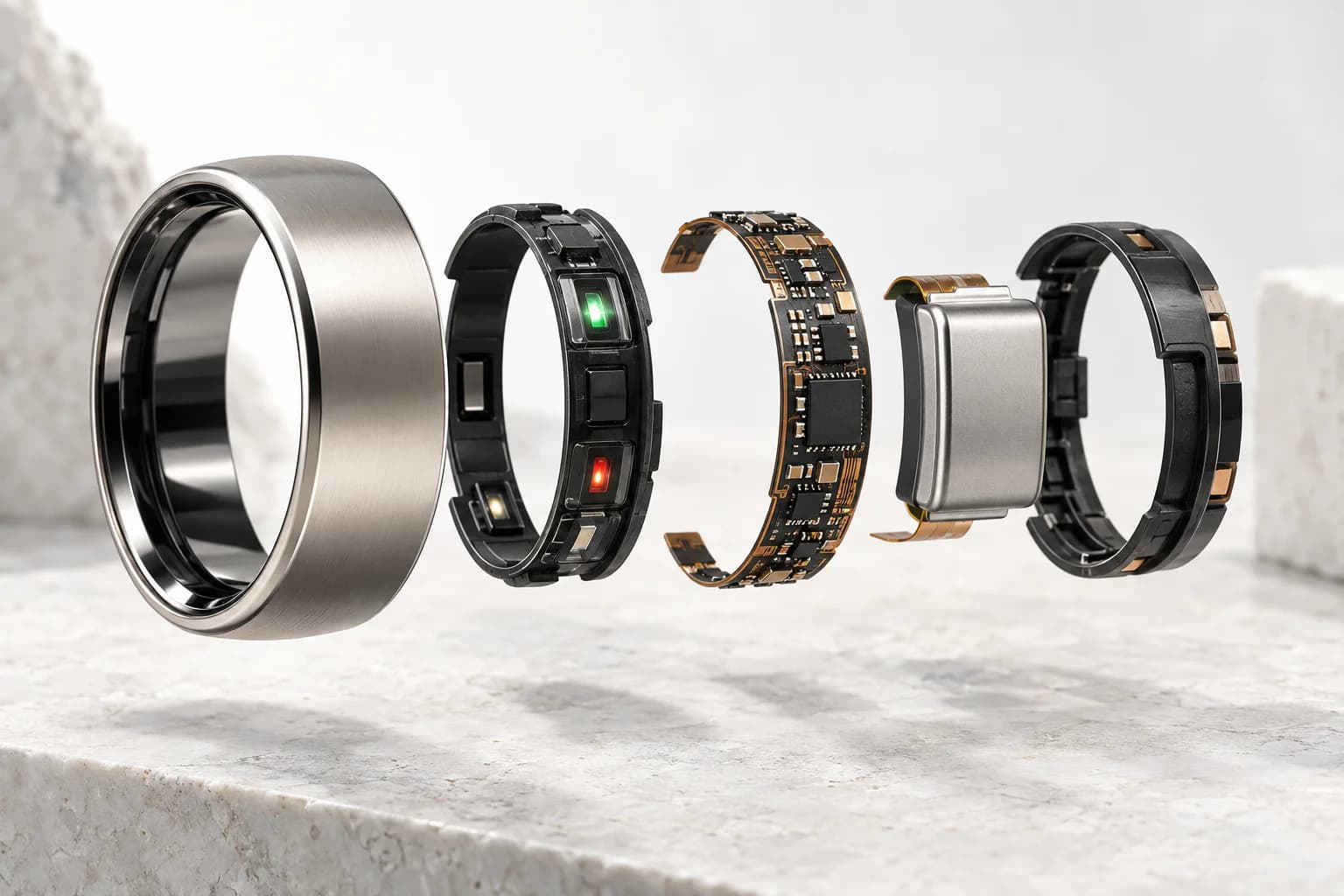
Short answer: A smart ring is a compact wearable device worn on the finger. Sensors inside the ring collect signals such as pulse-wave changes, movement and skin temperature. The ring sends those signals to a smartphone app, where algorithms estimate health and wellness trends including sleep, heart rate, HRV, recovery and daily activity.
At first glance, a smart ring looks like ordinary jewelry. There is no large display, visible strap or obvious control panel. That simplicity is intentional: most health-focused smart rings are designed to collect data quietly in the background while the app does the explaining.
The result is a different kind of wearable. A smartwatch asks for attention through a screen. A smart ring is primarily built for passive, continuous tracking.
What Makes a Ring “Smart”?
A ring becomes a smart ring when it combines three basic systems:
- Sensors that collect signals from the finger.
- Wireless communication that transfers data to a phone or connected device.
- Software and algorithms that turn raw signals into understandable information.
Some smart rings focus on wellness tracking. Others may support payments, access control, gestures or notifications. This guide focuses on health and fitness smart rings—the category designed to follow sleep, cardiovascular signals, temperature and activity.
Why Put Health Sensors on a Finger?
The finger is more than a convenient place to wear jewelry. It can also be a useful sensing location.
Fingers contain a dense network of small blood vessels. Optical sensors can observe changes in blood volume close to the skin, while the ring form helps hold the sensing surface in a relatively consistent position.
Research on wearable photoplethysmography, or PPG, explains that the optical signal reflects changes in arterial blood volume and is widely used to monitor heart rate. Ring-based sensor research also highlights the finger’s dense capillary distribution and potential for high-quality pulse signals.
The location has practical advantages:
- The ring can remain close to the skin without a strap.
- It may feel less intrusive during sleep than a watch.
- There is no bright screen competing for attention.
- Several days of battery life can support more continuous data collection.
- The form factor can fit both everyday and formal settings.
There is also a condition: fit matters. A ring that is too loose may rotate or lose contact. A ring that is too tight can become uncomfortable and should never be tolerated simply for data collection.
What Sensors Are Inside a Smart Ring?
The exact hardware differs by model, but health-tracking smart rings commonly contain several types of sensors.
Optical PPG sensors
PPG sensors use light to observe changes associated with blood flow. From these pulse-wave signals, a device may calculate or estimate:
- Heart rate.
- Resting heart rate.
- Heartbeat intervals used for HRV.
- Blood-oxygen trends when appropriate red and infrared optical components are present.
- Supporting information for respiratory and sleep algorithms.
PPG is not the same as an electrocardiogram. PPG observes pulse-related blood-volume changes; ECG measures the heart’s electrical activity.
Temperature sensors
Temperature sensors track the temperature of the skin at the finger. They do not directly measure internal core body temperature.
The most useful information is often the direction and consistency of change across multiple nights. Room temperature, bedding, circulation, alcohol, illness and menstrual-cycle changes can all influence skin temperature.
Accelerometer
An accelerometer detects movement and changes in motion. It helps estimate:
- Daily activity.
- Periods of inactivity.
- Sleep and wake timing.
- Nighttime movement.
- Some exercise patterns.
A ring does not usually have built-in GPS, so route, pace and distance tracking during outdoor training may still depend on a phone or watch.
Battery, processor and wireless connection
Miniature electronics manage sensing, store data temporarily and connect the ring to its companion app, typically through Bluetooth Low Energy.
The ring itself collects; the app organizes and interprets.
How Does a Smart Ring Turn Signals Into Health Trends?
The process can be understood in five steps.
Step 1: The sensors sample the body
During sleep, rest and daily activity, the ring repeatedly collects optical, movement and temperature signals.
Step 2: The device checks signal quality
Software identifies usable sections and attempts to reduce noise caused by hand movement, loose fit or inconsistent contact.
Step 3: Data is transferred to the app
When the ring syncs, the phone receives stored information. Some features may update throughout the day; others depend on complete overnight data.
Step 4: Algorithms combine several signals
One signal rarely tells the full story. For example, a low-movement period could mean sleep—or simply lying still. Adding heart rate, HRV, temperature and timing gives the algorithm more context.
Step 5: The app presents patterns and scores
The app may show sleep timing, resting heart rate, HRV, activity, recovery or an overall energy-related summary. These results are interpretations built from collected signals, not a direct view inside the body.
What Can a Smart Ring Track?
Sleep
A smart ring may estimate bedtime, wake time, total sleep, interruptions and likely sleep stages. Because consumer rings do not directly measure brain waves, light, deep and REM sleep are algorithmic estimates.
For many users, the most useful sleep outputs are timing, duration, consistency and changes across several nights.
Heart rate
The ring can follow heart rate during rest, sleep and parts of the day. Finger PPG may provide stable nighttime signals when the ring fits correctly and movement is low.
During rapid movement, intervals or grip-heavy exercise, readings can become less stable. A sports watch or chest strap may remain more appropriate for live training feedback.
Heart rate variability
HRV describes variation in the intervals between heartbeats. It is commonly interpreted in relation to autonomic nervous system activity, recovery, sleep and physiological load.
Your HRV should primarily be compared with your own recent pattern under similar conditions. A single number is rarely meaningful without context.
Skin temperature
Skin-temperature trends can help show whether overnight conditions differ from usual. A change does not identify the cause. Environment, sleep, travel, alcohol, menstrual-cycle changes and temporary physiological strain may all contribute.
Blood oxygen
When a ring includes the necessary optical hardware and validated processing, it may estimate blood-oxygen saturation or overnight oxygen trends. Consumer readings are intended for wellness context unless the specific function has appropriate medical authorization.
Activity
An accelerometer can estimate steps, movement, inactivity and energy expenditure. Rings are useful for passive daily activity tracking but may not match a GPS watch for route, pace, elevation or complex workout analysis.
Stress and recovery context
A sensor does not directly measure “stress” as a substance in the body. Apps infer stress or recovery context by combining signals such as HRV, heart rate, sleep, temperature and activity.
These summaries can be helpful when they encourage users to explore the underlying data rather than accepting one score as a diagnosis.
What Is the Difference Between Measuring and Estimating?
This distinction prevents many misunderstandings.
| Layer | Example | What it means |
|---|---|---|
| Sensor signal | Reflected optical pulse waveform | Physical signal collected at the finger |
| Calculated metric | Heart rate or heartbeat interval | Derived from detected pulse cycles |
| Algorithmic estimate | Sleep stage, stress or recovery | Interpretation combining several metrics |
| User insight | “My recovery pattern changed this week” | Conclusion formed from trends plus real-life context |
The farther a result moves from the original sensor signal, the more interpretation is involved. This does not make the result useless; it means the user should understand its level of certainty.
What Is a Smart Ring Most Useful For?
Building a continuous picture
A single heart-rate or sleep reading is a snapshot. Wearing a ring consistently can connect those snapshots into days and weeks.
Finding changes from your usual pattern
You may notice that sleep timing has shifted, overnight heart rate has risen, HRV has changed and activity has fallen during the same period.
The ring cannot automatically prove the cause, but it can help you recognize that several signals have moved together.
Connecting behavior with the following day
Late meals, alcohol, travel, hard training, stress and irregular schedules may coincide with changes in nighttime and recovery data. Repeated patterns can help users test practical adjustments.
Tracking without another screen
A screen-free wearable can collect information without adding notifications to the wrist. This is valuable for people who want passive monitoring but do not want another interactive device.
Smart Ring vs Smartwatch: What Is the Difference?
Neither device is universally better. They solve different problems.
| Smart ring | Smartwatch |
|---|---|
| Discreet and screen-free | Interactive display and notifications |
| Often comfortable for sleep | More visible and sometimes bulkier overnight |
| Strong focus on passive wellness trends | Strong focus on workouts, GPS and real-time feedback |
| Usually longer battery life than many full smartwatches | More frequent charging on many models |
| Limited live controls | Calls, messages, maps, apps and music controls |
Choose a ring if sleep, recovery, low distraction and continuous wear matter most. Choose a watch if live pace, GPS, notifications and on-device interaction matter most. Some users combine both.
What Can’t a General Wellness Smart Ring Do?
A consumer smart ring should not be assumed to:
- Diagnose a disease or sleep disorder.
- Replace an ECG, blood test, cuff-based blood-pressure measurement or sleep study.
- Explain the cause of an unusual heart rate, temperature or oxygen reading.
- Guarantee that a normal-looking score means nothing is wrong.
- Provide emergency medical monitoring unless a specific authorized feature explicitly supports that use.
The FDA’s 2026 general-wellness guidance distinguishes non-invasive wellness trends from products intended for diagnosis, treatment or disease management. It also cautions against presenting general wellness products as “medical grade” or “clinical grade” without the appropriate basis and regulatory context.
Seek professional care for severe, persistent or worsening symptoms regardless of what the app displays.
What Should You Look for Before Buying a Smart Ring?
- Metrics that match your goal. Sleep and recovery users need different features from runners seeking live GPS.
- Phone compatibility. Confirm support for your operating system and preferred health platform.
- Sizing system. Use the manufacturer’s sizing sample rather than relying on a standard jewelry size.
- Battery and charging. Consider real-world charging habits, not only maximum advertised days.
- Subscription cost. Check which insights remain available without a monthly plan.
- App quality. A screen-free ring depends heavily on clear software and reliable syncing.
- Data and privacy controls. Understand where health data is stored and what can be exported or deleted.
- Evidence and claims. Look for transparent validation rather than a long list of unsupported medical promises.
How EnergyMo SmartRing Works in Everyday Life
EnergyMo SmartRing is designed to collect wellness signals from the finger and organize them in the EnergyMo app. Users can review connected information across sleep, heart rate, HRV, skin temperature, blood oxygen, stress context and daily activity.
The goal is not to make one isolated number look definitive. It is to help users see whether several parts of their routine and physiology are changing together.
For example:
- Sleep becomes shorter for several nights.
- Overnight heart rate moves higher.
- HRV trends lower.
- Activity drops.
- The app shows that overall recovery context has changed.
The useful next step is not self-diagnosis. It is adding context: Have you traveled, trained harder, eaten later, felt unwell or faced unusual stress? If changes persist or symptoms concern you, a qualified healthcare professional can provide the appropriate evaluation.
Key Takeaways
- A smart ring is a sensor-based wearable designed for the finger.
- It commonly uses PPG, movement and temperature sensors.
- The app converts raw signals into heart rate, HRV, sleep, activity and recovery trends.
- Some outputs are measured or calculated; others are algorithmic estimates.
- The main advantage is passive, continuous, screen-free tracking.
- Fit, consistent wear and app quality affect usefulness.
- A general wellness smart ring does not replace medical testing or diagnosis.
Frequently Asked Questions
What is a smart ring used for?
A health-focused smart ring is used to track sleep, pulse-related signals, HRV, skin-temperature changes and activity, then present those measurements as wellness trends in a mobile app.
How does a smart ring work without a screen?
The ring collects and stores sensor data, then sends it to a phone through a low-energy wireless connection. The companion app displays the results.
Does a smart ring work without a phone?
Many rings can collect data temporarily without the phone nearby, but a compatible smartphone and app are generally needed for setup, syncing and viewing insights. Check the specific model’s requirements.
Does a smart ring have GPS?
Most health smart rings do not include standalone GPS. Outdoor route and pace data may come from a connected phone or another wearable.
Can a smart ring track sleep accurately?
It can provide useful estimates of sleep timing, duration and consistency. Exact sleep stages are inferred from multiple signals and are not equivalent to brain-wave-based clinical scoring.
Is a smart ring a medical device?
Not automatically. Many products are intended for general wellness. Regulatory status depends on the specific function, intended use, claims and authorization—not simply the ring form.
Sources and Further Reading
- Smart Ring in Clinical Medicine: A Systematic Review
- Wearable Photoplethysmography for Cardiovascular Monitoring
- Accuracy Assessment of Smart-Ring Nocturnal Heart Rate and HRV
- FDA General Wellness: Policy for Low Risk Devices
- EnergyMo Health Features
Wellness notice: EnergyMo SmartRing supports general wellness awareness and trend tracking. It is not a substitute for professional medical advice, diagnosis or treatment.