
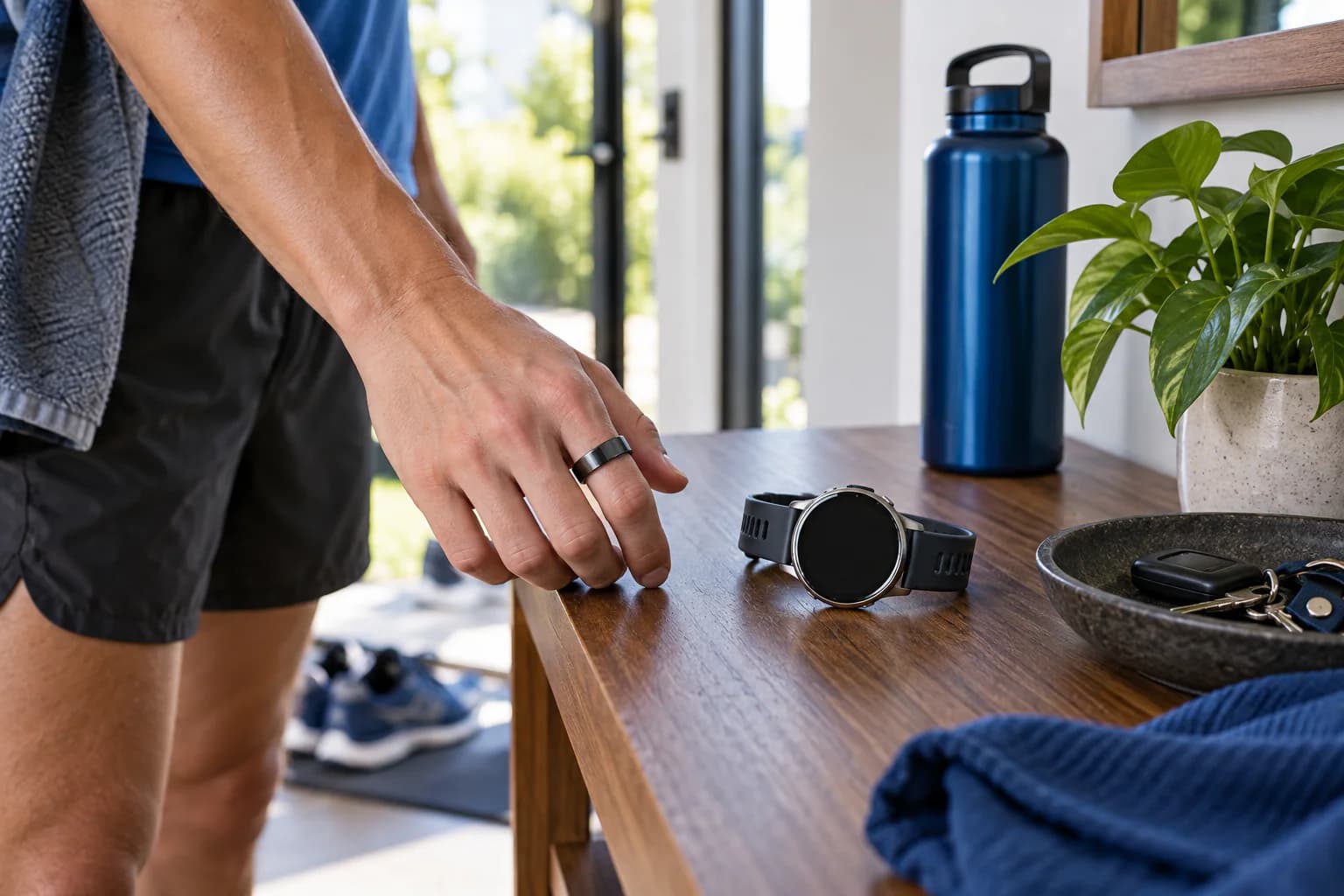
Short answer: a smart ring can replace a smartwatch for some people—but usually only if their main priorities are sleep, recovery, everyday health trends and low-distraction wear.
If you regularly use your watch for GPS routes, live workout metrics, messages, calls, music, maps, contactless payments or emergency features, a screenless smart ring is not a complete replacement.
The most useful question is not simply “Which device is better?” It is:
What job do you expect your wearable to do?
A smart ring is primarily a quiet sensor. A smartwatch is a sensor plus a small interactive computer. Once you understand that difference, the choice becomes much easier.
What Does “Replace My Watch” Actually Mean?
People use the word “watch” to describe very different habits.
One person wears a smartwatch only to track sleep, steps and resting heart rate. Another uses it to pace every run, navigate without a phone, receive urgent messages and make payments. A smart ring may replace the first person’s watch almost completely while replacing only a small part of the second person’s experience.
Before comparing products, divide smartwatch use into four jobs:
- Passive health tracking: sleep, resting heart rate, HRV, temperature trends and daily activity.
- Active fitness tracking: real-time pace, heart rate, distance, intervals, zones and route data.
- Communication and utility: notifications, calls, messages, timers, maps, music and payments.
- Safety and medical-adjacent features: emergency calling, fall detection, ECG or regulated health notifications on supported models and in supported regions.
Most health-focused smart rings compete strongly in the first category. Their coverage of the other three categories is usually more limited.
Smart Ring vs. Smartwatch: Quick Comparison
| Feature | Smart ring | Smartwatch |
|---|---|---|
| Sleep comfort | Often excellent | Depends on watch size and band |
| Sleep and recovery trends | Core strength | Common on many models |
| Resting heart rate and HRV | Common | Common |
| Skin-temperature trends | Available on some models | Available on some models |
| Daily steps and activity | Common | Common |
| Live workout screen | Usually no | Yes |
| Built-in GPS route tracking | Uncommon | Common on fitness-focused models |
| Pace, zones and interval feedback | Limited without phone | Stronger |
| Notifications and messages | Usually absent or very limited | Core strength |
| Calls, music, maps and apps | Usually no | Available on many models |
| Emergency and fall features | Usually no | Available on some models |
| Interaction distraction | Very low | Higher because of screen and alerts |
| Typical charging frequency | Often less frequent | Often more frequent, model-dependent |
| Jewelry-like appearance | Strong | More visibly technological |
| Data viewing | Primarily in phone app | On watch and phone app |
The table describes broad category tendencies. Exact features vary by model, software, phone, region and subscription.
What a Smart Ring Can Replace Well
1. Overnight sleep tracking
For many users, sleep is the strongest reason to switch from a watch to a ring. A ring is smaller, has no bright screen and is less likely to catch on bedding. If it is correctly sized, it can feel less intrusive overnight than a watch and band.
This matters because consistent wear is part of useful sleep tracking. A device that stays on the body can build a more complete pattern of bedtime, wake time, sleep duration and nighttime cardiovascular signals.
Sleep stages remain algorithmic estimates on consumer rings and watches. Neither form factor should be confused with a clinical sleep study.
2. Resting heart rate and HRV trends
Smart rings commonly use optical sensors to record pulse-related signals, particularly during low-movement periods. Nighttime resting heart rate and HRV can help users observe how recovery changes after stress, travel, illness, alcohol, late meals or training.
The ring does not need to show the number on its surface. The value appears in the companion app, often with a daily or weekly interpretation.
3. Passive daily activity
If your goal is to know whether you moved enough, view steps, estimate calories and track general activity patterns, a ring may cover much of what you used a basic fitness watch for.
It is less suitable when you want detailed real-time sport feedback or a visible countdown during an interval session.
4. A daily recovery check
Smart rings are well suited to summarizing several signals into a readiness, recovery or energy-style view. The useful part is not the score alone. It is the connection between sleep, heart rate, HRV, temperature, activity and recent behavior.
For someone who checks a smartwatch only each morning to ask “How recovered am I?”, a smart ring may provide a more focused experience.
5. A low-distraction wearable
A ring has no stream of email previews, social notifications or app badges. That can be a feature rather than a limitation.
You still receive the insight when you open the app, but your wearable does not continuously compete for attention. People who want health context without another screen may prefer this relationship with technology.
What a Smart Ring Usually Cannot Replace
1. Real-time workout guidance
During a run, ride or interval workout, athletes may want to see:
- current heart rate;
- pace and distance;
- elapsed time;
- heart-rate zone;
- lap or interval alerts;
- navigation prompts;
- elevation or cadence;
- structured workout instructions.
A screenless ring cannot display these metrics. Some rings can record or automatically detect activity, but the experience is not the same as actively controlling a workout from the wrist.
2. Built-in GPS and route navigation
Many smartwatches record outdoor routes using built-in GPS. They may also display maps, directions or breadcrumb navigation.
Most health-focused smart rings do not provide an equivalent standalone navigation experience. Distance or route information may depend on a connected phone, an imported workout or another device.
If leaving your phone at home during a run is important, check the exact ring specification carefully. Do not assume that “activity tracking” includes standalone GPS.
3. Notifications, calls and messages
Mainstream smartwatches can show notifications and often let users answer calls or reply to messages. Cellular models may perform some of these tasks without a nearby phone, depending on carrier and region.
Most screenless health rings cannot replace that communication layer. A gesture to dismiss an alarm or control a phone is not equivalent to reading and responding to a message.
4. Maps, music, timers, payments and apps
A smartwatch can function as a remote control and small app platform. Users may change music, set a timer, check weather, view directions or make a contactless payment from the wrist.
A smart ring is normally designed to sense, sync and interpret—not to host a visual app ecosystem.
5. Emergency and model-specific health features
Some smartwatches include fall detection, emergency calling, location sharing, ECG or regulated notifications. Availability depends heavily on the model, country, age, phone and software.
Do not assume a general wellness smart ring offers the same capabilities. EnergyMo SmartRing should not be marketed as a substitute for an emergency device, ECG, clinical monitor or medical alert system.
Is a Smart Ring Better for Sleep Than a Smartwatch?
It can be better for wearability, but that does not automatically mean it is more accurate.
A smaller form factor, no display and less wrist coverage may make a ring easier to wear all night. The finger can also be a useful site for optical pulse sensing when the ring has stable contact.
Accuracy depends on much more than body location:
- sensor design;
- fit and orientation;
- algorithm quality;
- skin contact;
- movement;
- device generation;
- the metric being measured;
- individual physiology.
Compare validation evidence for the exact models if accuracy is your primary concern. Never use one brand’s study as proof for the entire category.
Is a Smartwatch Better for Exercise?
For structured training, a smartwatch or dedicated sports watch is usually more capable.
The reason is not simply that it has more sensors. The display creates an immediate feedback loop. You can see pace, zones and intervals while moving, then adjust effort in real time. Built-in GPS can also record route and speed without relying on a ring.
A smart ring can still be useful around the workout. It may help connect training with sleep, nighttime HRV, resting heart rate and next-day recovery. Think of the ring as the device that observes the broader recovery cycle, while the sports watch manages the session itself.
Which Device Is Less Distracting?
The answer is almost always the ring.
A smartwatch can reduce phone use when it lets you handle a task quickly. It can also create another stream of interruptions on the body. Which effect dominates depends on how notifications are configured.
A screenless ring creates deliberate friction: you must choose to open the phone app. This makes it less useful for immediate information but more compatible with people who do not want health tracking to become constant interaction.
Which Device Has Better Battery Life?
Smart rings often last multiple days because they do not power a display, speaker, GPS interface or large app ecosystem. Smartwatch battery life varies widely and depends on display settings, GPS, cellular use, workouts and model.
Official current examples illustrate the category difference but should not be treated as universal rules:
- Samsung advertises up to seven days for its current Galaxy Ring under stated conditions.
- Oura lists multi-day ranges that vary by ring generation and use.
- Apple’s battery documentation describes watch endurance based on a mixture of screen checks, notifications, app use, workouts and sleep tracking.
Always compare the exact product’s official battery test and real use. A claimed maximum is not a guarantee, and battery capacity declines over time.
For a sleep tracker, charging timing matters as much as maximum days. A ring that charges while you shower or work at a desk may be easier to keep on overnight.
Can a Smart Ring Replace a Fitness Tracker?
If “fitness tracker” means steps, general movement, estimated calories, resting heart rate and sleep, often yes.
If it means GPS routes, live pace, detailed sport modes, interval coaching and on-device controls, usually not completely.
This is why product category labels can be misleading. Make a list of functions you actually use rather than comparing the number of features advertised.
Who Can Replace a Smartwatch With a Smart Ring?
A smart ring may be enough if you:
- mainly care about sleep and recovery;
- want passive health trends rather than live dashboards;
- carry your phone most of the time;
- do not need wrist notifications;
- prefer a jewelry-like wearable;
- remove your watch at night;
- want fewer screens and interruptions;
- exercise recreationally without detailed live metrics.
For this user, a ring is not a smaller watch. It is a better match for a quieter form of tracking.
Who Should Keep a Smartwatch?
Keep a smartwatch or sports watch if you regularly use:
- built-in GPS without a phone;
- live pace, zones or interval screens;
- navigation during hiking, cycling or running;
- wrist-based messages, calls or notifications;
- contactless payments;
- music controls or offline audio;
- timers and apps throughout the day;
- supported emergency, fall-detection or regulated health features.
If one of these functions affects your safety or training, do not replace it based only on comfort or battery life.
Should You Wear a Smart Ring and a Smartwatch Together?
For some users, the best answer is not either/or.
A practical two-device setup is:
- smart ring: sleep, nighttime physiology, everyday recovery and low-interruption tracking;
- smartwatch: GPS workouts, live performance metrics, maps, music, messages and safety features.
This combination makes sense only when each device has a clear role. Otherwise, you may pay twice, charge twice and receive conflicting scores for the same night.
To avoid data confusion:
- Choose one primary source for sleep.
- Choose one primary source for workouts and route data.
- Review app permissions to prevent duplicate activities.
- Do not compare proprietary scores as if they use the same formula.
- Focus on the trend within one device rather than switching sources every day.
Smart Ring or Smartwatch: Five Questions to Decide
1. What do you check most often?
If the answer is sleep and recovery in the morning, choose a ring. If it is pace, maps and messages during the day, keep a watch.
2. Do you need information without opening your phone?
A smartwatch provides immediate visual access. A screenless ring usually asks you to use the companion app.
3. Do you wear your current watch to sleep?
If not, a ring may fill the biggest gap in your data.
4. Do you train with live metrics?
If you adjust pace or effort from a wrist display, a ring alone will feel limited.
5. Are notifications helping or distracting you?
If you want fewer interruptions, the absence of a ring display can be an advantage.
How EnergyMo SmartRing Fits Into the Choice
EnergyMo SmartRing is designed for people who want to understand health patterns without wearing another screen. It brings sleep, heart rate, HRV, blood-oxygen, skin-temperature, stress-context and activity information into the EnergyMo app, where users can review how those signals relate to daily energy and recovery.
That makes EnergyMo a strong alternative to a watch used mainly for passive wellness tracking. It does not mean the ring should be positioned as a replacement for standalone GPS, messaging, maps, payments, emergency calling or clinical monitoring.
The clearest brand promise is:
EnergyMo replaces some of the reasons people wear a watch—not every function a smartwatch can perform.
For users who want fewer distractions and more attention to sleep and recovery trends, that narrower role may be exactly the benefit.
Final Verdict
Can a smart ring replace a smartwatch? Yes, if your watch is primarily a health tracker. No, if it is also your workout computer, communication device, navigator or safety tool.
Choose a smart ring for passive, comfortable and low-distraction observation. Choose a smartwatch for active interaction and real-time feedback. Use both when the roles are genuinely different.
The best wearable is not the one with the longest feature list. It is the one you will wear consistently—and the one that gives you information you can actually use.
Frequently Asked Questions
Can a smart ring completely replace an Apple Watch?
Only for users who mainly use Apple Watch for passive wellness trends. A smart ring generally cannot replace its display, apps, messages, calls, GPS, maps, payments or supported emergency features.
Is a smart ring better than a smartwatch?
Neither is universally better. A ring often wins for sleep comfort, discretion and low distraction. A smartwatch usually wins for workouts, GPS, communication and on-device interaction.
Is a smart ring good for running?
It can record general activity and recovery context, depending on the model. Runners who need live pace, distance, route maps or interval guidance will usually still prefer a GPS watch.
Can a smart ring track steps without a phone?
Many rings can collect movement data while the phone is not immediately present and sync later, but storage and synchronization rules vary. Check the exact EnergyMo model and app requirements.
Do I need both a smart ring and a smartwatch?
No. Use both only if the ring handles sleep and recovery while the watch handles live workouts or communication. If they perform the same job, the extra cost and duplicate data may not be worthwhile.
Is a smart ring better for sleep tracking?
It may be more comfortable and therefore easier to wear consistently. Accuracy must be evaluated by specific device and metric; the ring form factor alone does not guarantee better results.
Does EnergyMo SmartRing have a screen or GPS navigation?
EnergyMo is designed as a screenless wellness ring whose detailed insights are viewed in the EnergyMo app. Do not describe it as a replacement for a smartwatch display or standalone navigation unless a specific future model officially adds those capabilities.
Sources and Further Reading
- EnergyMo Smart Ring for Holistic Health Tracking — official product and feature overview.
- Why Apple Watch — official overview of watch health, fitness, communication and safety use cases.
- Use Apple Watch Without Its Paired iPhone — official connectivity and utility documentation.
- Set Up Cellular Service on Apple Watch — official call, message and streaming capabilities.
- Explore Galaxy Ring — official smart-ring health, activity, battery and interaction overview.
- Oura Ring Battery Information — official examples of model-dependent smart-ring battery ranges.
- Google Pixel Watch Activity and GPS Tracking — official smartwatch workout and GPS documentation.
Health notice: EnergyMo SmartRing is a consumer wellness device. It is not intended to diagnose, treat, cure or prevent disease and should not replace professional medical care, an emergency device or a prescribed clinical monitor.
中文官网文章
Continue Exploring
EnergyMo products are consumer wellness devices, not medical devices. They are not intended to diagnose, treat, cure, or prevent any disease. Information provided is not medical advice.
Track what your body is telling you
EnergyMo Ring brings sleep, recovery, and daily movement into one discreet wearable.