
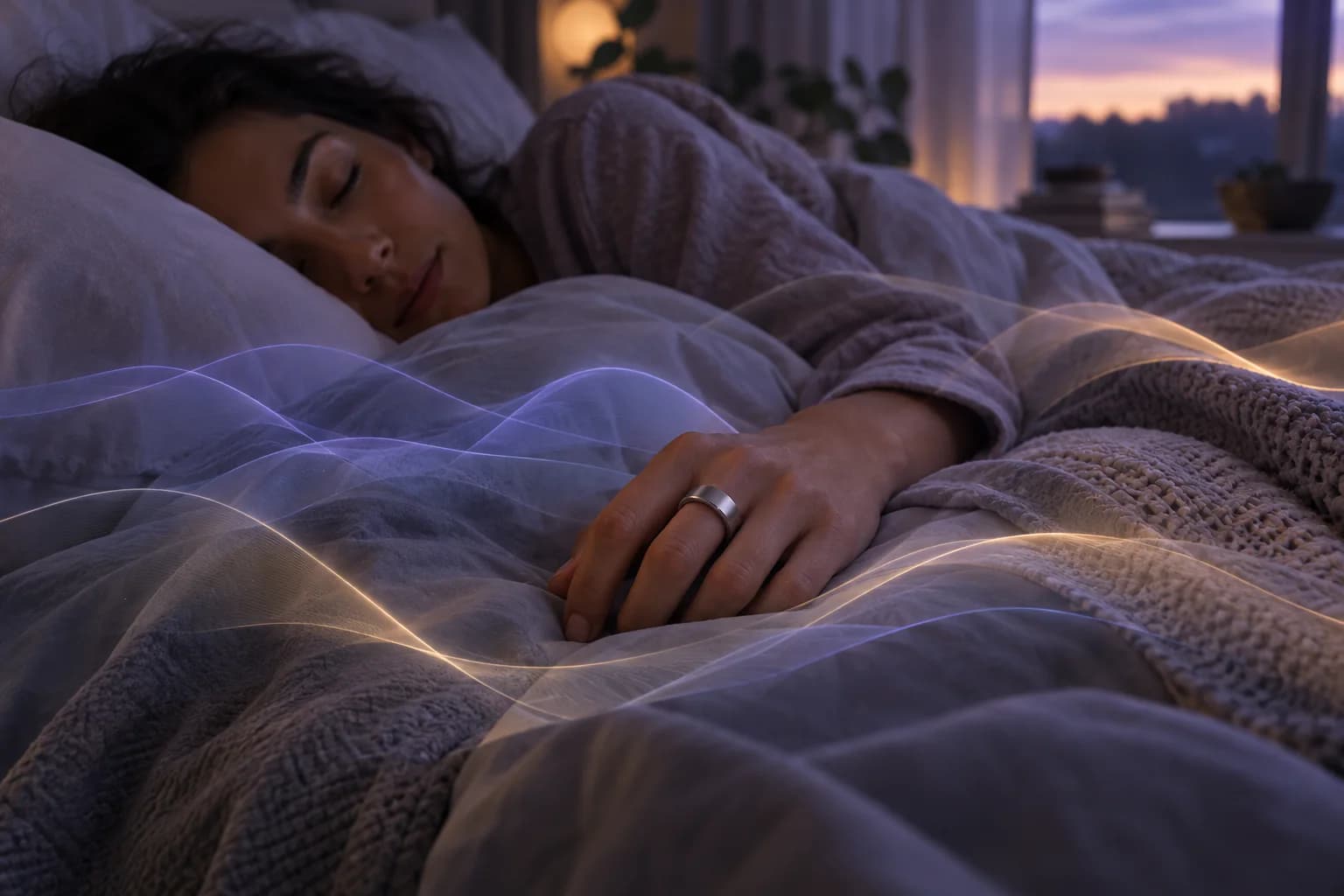
Short answer: a well-designed smart ring can be useful for estimating when you fell asleep, when you woke up, how long you slept and how those patterns change over time. Sleep-stage results—light, deep and REM—should be treated as informed estimates rather than exact measurements.
That distinction matters. A smart ring sits on your finger. It can measure signals such as movement, pulse patterns, heart rate variability and skin temperature, but it does not directly record the electrical activity of your brain. A clinical polysomnography test does.
So, are smart rings accurate for sleep? They can be accurate enough to reveal practical trends, especially when used consistently. They are not a replacement for a medical sleep study, and a single night’s sleep-stage chart should not be read as a diagnosis.
What Does “Accurate” Mean in Sleep Tracking?
Accuracy is not one single number. A sleep tracker may perform well on one metric and less well on another.
When evaluating smart ring sleep tracking accuracy, separate these questions:
- Did the ring correctly detect sleep versus wake?
- Did it estimate total sleep time reasonably well?
- Did it identify bedtime and wake time?
- Did it detect awakenings during the night?
- Did it classify light, deep and REM sleep correctly?
- Does it show useful trends across multiple nights?
A device can estimate total sleep time well while still misclassifying individual sleep stages. It can also produce a nightly total that looks correct even though some 30-second periods were assigned to the wrong stage.
This is why a simple claim such as “the ring is 90% accurate” is rarely enough. You need to know what was measured, which device and algorithm were tested, who participated, and what reference method was used.
How Does a Smart Ring Track Sleep?
Most consumer smart rings do not observe sleep directly. They combine several body signals and use an algorithm to estimate your sleep state.
Common inputs include:
- Movement: an accelerometer detects stillness, turning and larger movements.
- Heart rate: nighttime heart-rate patterns can differ across wakefulness and sleep.
- Heart rate variability: beat-to-beat variation provides information about autonomic activity.
- Pulse waveform: optical PPG sensors detect blood-volume changes in the finger.
- Respiratory patterns: breathing-related information may be derived from pulse and movement signals.
- Skin temperature trends: temperature changes can add context to circadian and recovery patterns.
- Time and sleep history: algorithms may use time of night and recent patterns as contextual features.
Machine-learning models compare the combination of these signals with patterns learned from reference sleep data. The result is a probability-based classification—not a direct view of what the brain is doing.
Why the Finger Can Be Useful for Overnight Tracking
The finger has a rich blood supply, which can support optical pulse sensing when the ring fits correctly and the sensors maintain stable skin contact. A ring is also small, screen-free and often comfortable during sleep.
Those qualities can help with consistency. A technically capable device cannot build a useful seven-night trend if the user removes it every night because it is uncomfortable.
However, the finger location is not automatically accurate. A loose fit, rotated sensors, cold hands, pressure on the hand, movement artifacts or poor contact can reduce signal quality.
Smart Ring vs. Polysomnography: What Is the Difference?
Polysomnography, often called a sleep study or PSG, is the clinical reference standard for evaluating sleep. It can record multiple signals, including:
- brain activity through electroencephalography (EEG);
- eye movements through electrooculography (EOG);
- muscle activity through electromyography (EMG);
- heart rhythm;
- airflow and breathing effort;
- blood oxygen, depending on the study setup.
These signals allow trained professionals to classify sleep stages and evaluate possible sleep disorders.
A smart ring uses a much smaller set of indirect signals. It can infer that a pattern resembles REM or deep sleep, but it cannot directly confirm the brain-wave features used in clinical scoring.
| Measurement question | Smart ring | Clinical sleep study |
|---|---|---|
| Convenient for repeated nights | Usually yes | Usually limited |
| Measures movement and pulse trends | Yes | Yes, with more channels |
| Directly records brain waves | No | Yes |
| Estimates consumer sleep stages | Yes | Clinically scores stages |
| Useful for long-term lifestyle trends | Yes | Not usually its main purpose |
| Can diagnose a sleep disorder | Not by itself | Used as part of clinical evaluation |
The two tools answer different questions. A sleep study provides deeper clinical measurement for a limited period. A smart ring offers convenient, repeated observation in everyday life.
What Does Research Say About Smart Ring Sleep Accuracy?
Research results vary by product generation, algorithm, study population and metric. One independent 2024 study compared Oura Ring Gen3, Fitbit Sense 2 and Apple Watch Series 8 with polysomnography in 35 healthy adults during one inpatient night.
In that specific study:
- all three devices had at least 95% sensitivity for detecting sleep versus wake;
- Oura Ring sleep-stage sensitivity ranged from 76.0% to 79.5%;
- the researchers reported moderate-to-substantial agreement with PSG-derived sleep stages;
- agreement for certain nightly deep-sleep and REM totals was still limited, despite no significant difference in group averages.
These figures are useful evidence about the tested Oura Ring Gen3 and the conditions of that study. They are not a universal accuracy score for every smart ring, and they should not be presented as EnergyMo validation data.
A 2024 review of wearable sleep-staging research found reported four-stage accuracy of roughly 69% to 79% in the studies it examined. The review also highlighted major limitations: proprietary algorithms, inconsistent validation methods and limited access to raw data.
The practical conclusion is balanced: modern multisensor wearables can produce meaningful sleep estimates, but sleep-stage classification remains imperfect and product-specific.
Which Sleep Metrics Are Usually More Reliable?
Sleep timing
Bedtime and final wake time are often among the most useful outputs, especially when the ring is worn consistently and the user is not lying still in bed for long periods while awake.
Total sleep time
Total sleep time can be directionally useful. It may still be overestimated if quiet wakefulness is counted as sleep or underestimated when movement is interpreted as wakefulness.
Sleep consistency
Repeated bedtime, wake time and sleep-duration patterns can be more actionable than a single sleep score. This is where continuous, low-friction wear can add real value.
Nighttime heart-rate and HRV trends
These are measured physiological signals rather than named sleep stages, although their quality still depends on sensor contact and algorithmic processing. They may help place sleep within a broader recovery pattern.
Sleep stages
Light, deep and REM sleep are more difficult. Without EEG, the ring estimates stages from physiological patterns that overlap between stages and vary between people.
Why Can Deep Sleep and REM Differ Between Devices?
Two trackers can observe the same night and produce different stage charts because they may use:
- different sensors;
- different sampling rates;
- different signal-quality rules;
- different definitions and stage-merging methods;
- different machine-learning training data;
- different update versions;
- different thresholds for brief awakenings.
Neither chart should be assumed correct simply because it looks more detailed. More granularity does not automatically mean more accuracy.
Even trained human scorers do not agree perfectly on every sleep-stage epoch. A scientific review cited inter-scorer agreement in the approximate range of 78.9% to 82.6%. This does not make consumer trackers equivalent to PSG; it shows that sleep staging itself has boundaries and interpretation rules.
Why Your Ring May Say You Slept While You Were Awake
Quiet wakefulness is one of the hardest cases for movement-based sleep detection. If you are lying still, reading, meditating or trying to fall asleep, the ring may see low movement and sleep-like heart-rate patterns.
Possible results include:
- sleep onset appearing earlier than you remember;
- nighttime wakefulness being shortened;
- total sleep time being overestimated;
- sleep efficiency appearing higher.
If your app allows you to confirm or edit bedtime, use that feature carefully. Do not change data simply to achieve a better score; correct only clearly known errors.
What Can Reduce Smart Ring Sleep Accuracy?
Loose or incorrect fit
The sensors need stable skin contact. A ring that spins freely or develops a visible gap may create weak or interrupted data.
Sensor position
If the ring has an intended sensor orientation, rotation can move the sensors away from the optimal position.
Cold hands or reduced peripheral circulation
Cold conditions can make optical pulse signals harder to capture at the finger.
Movement and pressure artifacts
Sleeping on your hand, repeated movement or pressure against the ring can affect the signal.
Short or irregular sleep
Naps, fragmented sleep, shift work and unusual schedules can be harder for algorithms trained around conventional nighttime sleep.
Alcohol, illness, medication or intense exercise
These can genuinely change heart rate, HRV, temperature and sleep structure. A surprising result is not always a sensor error—but it is not automatically a diagnosis either.
Algorithm updates
Manufacturers may improve or change sleep classification through software. Results from an older study may not describe the current algorithm, and current results may not match an older personal history exactly.
How to Get Better Sleep Data From a Smart Ring
- Choose the correct size. The ring should be snug, not tight, and comfortable overnight.
- Keep the sensors oriented correctly. Follow the instructions for the exact EnergyMo model.
- Wear it consistently. Multiple nights are more informative than an isolated night.
- Start with a charged ring. Avoid losing the second half of the night to low battery.
- Keep the sensor surface clean and dry. Residue and moisture can affect contact and comfort.
- Sync regularly. Confirm that the full night has transferred before interpreting missing sections.
- Add context. Note travel, alcohol, late meals, illness, medication, stress or hard training.
- Compare like with like. Look at similar weekdays, routines and sleep opportunities.
The Best Way to Read Smart Ring Sleep Data
The most useful question is not “Was my deep sleep exactly 67 minutes?” It is “What pattern keeps repeating, and what changed before it changed?”
Use this three-level approach:
Level 1: Check the night
Look for obvious gaps, an implausible bedtime or a ring-fit problem. Treat stage minutes as estimates.
Level 2: Check the week
Review average sleep duration, bedtime consistency, wake time, nighttime heart-rate patterns and how you felt during the day.
Level 3: Check the context
Compare the trend with behavior: caffeine timing, alcohol, late exercise, travel, stress, room temperature and illness.
This turns the ring from a nightly scorekeeper into a tool for testing habits.
Do Not Let the Sleep Score Create More Stress
Some people become so focused on achieving “perfect” sleep data that the tracker increases anxiety. This pattern is sometimes called orthosomnia.
If a low score makes you feel worse even when you feel rested, step back from the number. Your daytime function, sleepiness, mood and lived experience are important context. A tracker should support better decisions—not make sleep feel like an exam.
Can a Smart Ring Detect Insomnia or Sleep Apnea?
A general wellness smart ring should not be used on its own to diagnose insomnia, sleep apnea or another sleep disorder.
The American Academy of Sleep Medicine states that consumer sleep technology without appropriate validation and regulatory clearance should not be used to diagnose or treat sleep disorders. Consumer data may still support a conversation with a qualified clinician.
Seek professional evaluation if you have concerns such as:
- persistent difficulty falling or staying asleep;
- loud, frequent snoring with pauses, gasping or choking;
- excessive daytime sleepiness;
- morning headaches with suspected breathing disruption;
- sleep-related behaviors that could cause injury;
- fatigue that persists despite enough time in bed.
Do not wait for a ring score to confirm symptoms that are already affecting your safety or daily life.
How to Use EnergyMo SmartRing Sleep Insights Responsibly
EnergyMo SmartRing is best used to connect sleep with your broader recovery picture. Instead of overreacting to one stage estimate, look at sleep duration and timing alongside nighttime heart rate, HRV, temperature trends, activity and Energy Level.
For example, one unusual night may be noise. Several nights of shorter sleep, lower HRV and a higher-than-usual nighttime heart rate may be a reason to reduce training load, review recent habits or pay closer attention to how you feel. It is still a wellness interpretation, not a medical diagnosis.
EnergyMo’s value comes from making patterns easier to notice. The responsible promise is not “a laboratory on your finger.” It is a convenient way to understand how daily choices and recovery signals move together.
Key Takeaways
- Smart rings estimate sleep using movement, optical pulse, heart-rate, HRV, temperature and contextual signals.
- They do not directly measure brain waves and cannot reproduce every channel of polysomnography.
- Sleep timing and total sleep trends are generally more dependable than exact stage-by-stage minutes.
- Published accuracy figures apply only to the specific product, algorithm, population and study design tested.
- A single night matters less than a repeated pattern across one or more weeks.
- A consumer smart ring cannot independently diagnose insomnia, sleep apnea or another sleep disorder.
Frequently Asked Questions
How accurate are smart rings for sleep?
They can be useful for estimating sleep timing, total sleep and long-term patterns. Accuracy varies by device, fit, algorithm, user and metric. Sleep stages are less certain than basic sleep-versus-wake detection.
Can a smart ring accurately detect deep sleep?
It can estimate deep sleep from movement and cardiovascular patterns, but it does not directly measure the brain waves used to confirm deep sleep in a clinical study. Treat the nightly number as an estimate and focus on trends.
Can a smart ring detect REM sleep?
It can classify periods that resemble REM using pulse, HRV, breathing and movement patterns. Misclassification is possible because the ring does not record eye movements or EEG directly.
Why does my smart ring show different sleep stages from my watch?
The devices may use different body locations, sensors, sampling rates and algorithms. Their stage labels and thresholds may also differ.
Is a smart ring more accurate than a smartwatch for sleep?
There is no universal winner. Performance depends on the exact models and metrics being compared. A ring may be easier to wear consistently, but comfort alone does not establish accuracy.
Should I worry about one night of low deep sleep?
Usually, one estimate is not enough to establish a problem. Review your fit, the complete weekly pattern and how you feel. Discuss persistent symptoms or sleep concerns with a healthcare professional.
Can EnergyMo SmartRing diagnose a sleep disorder?
No. EnergyMo SmartRing provides general wellness and trend information. It is not a substitute for professional evaluation or a clinical sleep study.
Sources and Further Reading
- Robbins R, et al. Accuracy of Three Commercial Wearable Devices for Sleep Tracking in Healthy Adults. Sensors. 2024.
- Birrer V, et al. Evaluating Reliability in Wearable Devices for Sleep Staging. npj Digital Medicine. 2024.
- Khosla S, et al. Consumer Sleep Technology: An American Academy of Sleep Medicine Position Statement. Journal of Clinical Sleep Medicine. 2018.
- Oura Support. Sleep Stages and Sleep Staging Algorithm.
- Samsung Support. Track Your Sleep With the Galaxy Ring.
Health notice: EnergyMo SmartRing is intended for general wellness and personal trend tracking. It does not diagnose, treat, cure or prevent any disease. If you have ongoing sleep problems, excessive daytime sleepiness, breathing pauses, chest symptoms or other concerning symptoms, consult a qualified healthcare professional.
中文官网文章
Continue Exploring
EnergyMo products are consumer wellness devices, not medical devices. They are not intended to diagnose, treat, cure, or prevent any disease. Information provided is not medical advice.
Track what your body is telling you
EnergyMo Ring brings sleep, recovery, and daily movement into one discreet wearable.