
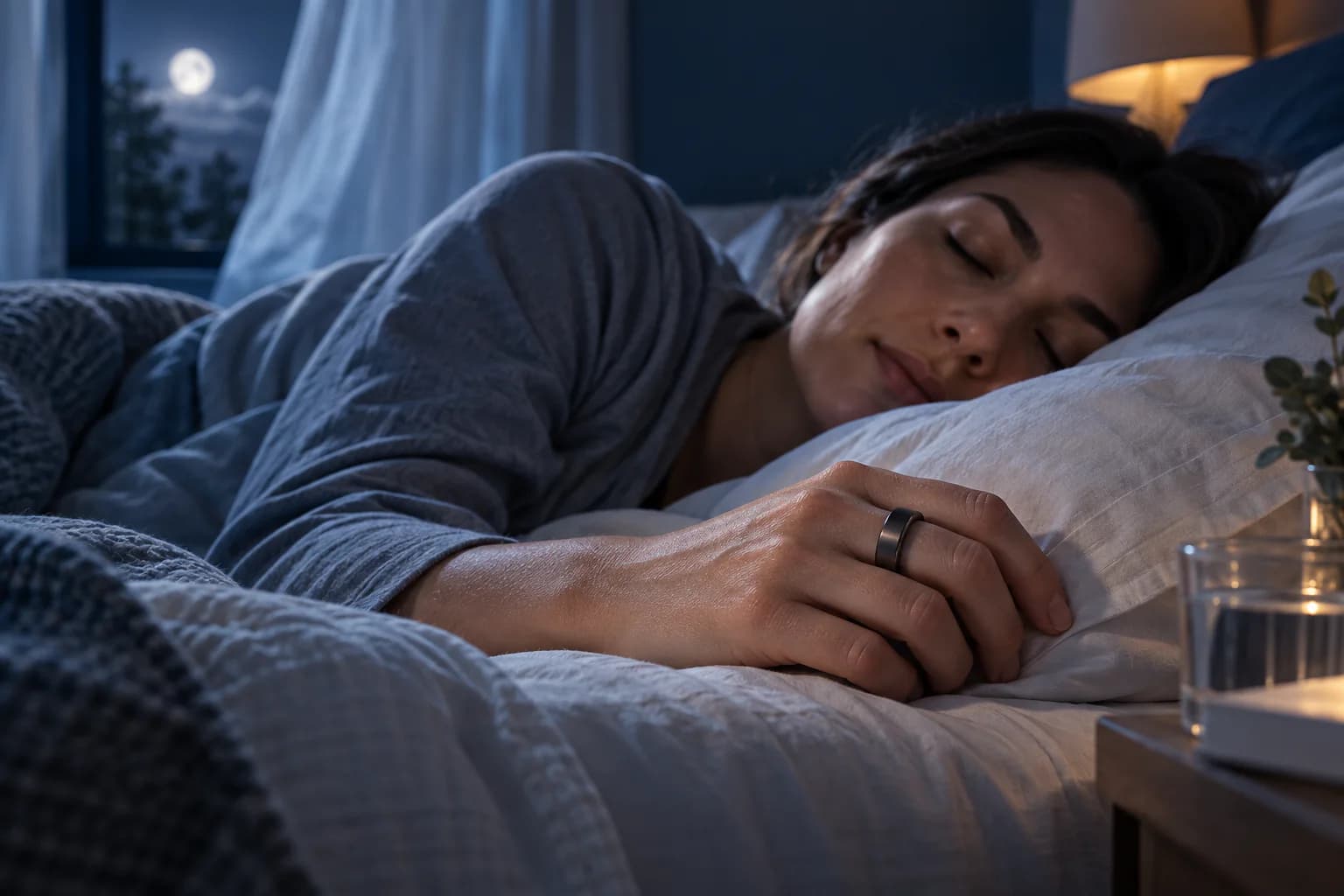
Short answer: Most consumer smart rings—including EnergyMo SmartRing—cannot diagnose or rule out sleep apnea. Depending on the model and enabled features, a ring may reveal overnight oxygen, pulse, movement, sleep continuity, respiratory-rate, or breathing-related trends. Those patterns can give you a reason to pay attention or speak with a healthcare professional, but they are not a clinical diagnosis.
Seeing an unexpected oxygen dip or a restless-night score can be unsettling. It is also easy to jump from “my ring noticed something” to “I have sleep apnea.” Those are not the same conclusion.
A smart ring can be a useful observer of nightly patterns because it sits close to the skin and can collect data while you sleep. But sleep apnea is a medical condition. Diagnosing it requires the right signals, validated analysis, clinical context, and—in many cases—a sleep study interpreted by a qualified professional.
This guide explains what a smart ring may notice, what it usually cannot establish, and how to use EnergyMo data responsibly.
What Is Sleep Apnea?
Sleep apnea is a disorder in which breathing repeatedly stops or becomes restricted during sleep. The most common form is obstructive sleep apnea (OSA), which happens when the upper airway repeatedly narrows or closes. Central sleep apnea involves the brain’s control of breathing and is a different clinical problem.
Breathing disruptions can fragment sleep and may be accompanied by oxygen changes, snoring, gasping, or daytime symptoms. However, a person may not remember waking, and not every person with sleep apnea has the same symptoms or wearable-data pattern.
“Detect” Can Mean Three Different Things
When people ask whether a smart ring can “detect” sleep apnea, they may mean one of three things:
| Meaning of “detect” | What it involves | Can a typical consumer smart ring do it? |
|---|---|---|
| Measure related signals | Record trends such as pulse, estimated blood-oxygen saturation, movement, or respiratory rate | Often, depending on the model and feature |
| Flag a pattern worth attention | Identify repeated or unusual changes that may justify further discussion | Sometimes, but false alarms and missed cases are possible |
| Diagnose or rule out sleep apnea | Establish a medical condition using validated criteria and appropriate clinical evaluation | No, unless the exact device and feature have specific regulatory authorization for that intended use |
That distinction matters. A graph can be informative without being diagnostic.
What Can a Smart Ring Measure During Sleep?
The exact sensors and calculations vary by product. A smart ring may use:
- Optical sensors (PPG) to estimate pulse and related cardiovascular patterns.
- Red and infrared light, on supported models, to estimate blood-oxygen saturation trends.
- Motion sensors to identify movement, stillness, and possible sleep-wake patterns.
- Temperature sensors to show changes relative to a personal baseline.
- Algorithms to estimate sleep duration, stages, continuity, respiratory rate, or breathing-related disturbances.
These measurements may reveal that several nights look different from your usual baseline. They may also help you organize observations before speaking with a clinician.
But a general wellness ring usually does not directly measure the full set of signals used in a clinical sleep evaluation, such as brain waves, airflow through the nose and mouth, chest and abdominal breathing effort, eye movements, muscle activity, and other channels.
Can Oxygen Dips Prove You Have Sleep Apnea?
No. An oxygen-related trend is only one part of the picture.
Oxygen readings can be affected by ring fit, finger temperature, movement, circulation, sleeping position, altitude, illness, and signal quality. A loose ring may lose clean skin contact; a very tight ring may be uncomfortable and is not a solution either. Consumer devices may also smooth or summarize data differently from medical equipment.
More importantly:
- Not every oxygen dip is caused by sleep apnea.
- Not every breathing event produces the same oxygen change.
- A normal-looking nightly graph does not rule out sleep apnea.
- A single unusual night does not confirm a chronic condition.
Think of the ring’s data as a clue that needs context—not as a verdict.
What a Sleep Study Measures That a Smart Ring Usually Does Not
Clinical diagnosis commonly relies on polysomnography (PSG) or, for selected adults, a technically adequate home sleep apnea test (HSAT) ordered and interpreted within an appropriate clinical pathway.
| Capability | Consumer smart ring | Home sleep apnea test | In-lab polysomnography |
|---|---|---|---|
| Pulse and oxygen-related data | Often estimated | Commonly measured with validated equipment | Measured |
| Movement and estimated sleep | Common | Varies; many HSATs do not directly measure sleep stages | Measured with multiple channels |
| Airflow | Usually not directly measured | Commonly measured | Measured |
| Respiratory effort | Usually not directly measured | Commonly measured | Measured |
| Brain waves and true sleep staging | No | Usually no | Yes |
| Clinical event scoring | No | Yes, within the test’s validated workflow | Yes |
| Appropriate for diagnosis | General wellness only unless specifically authorized | For suitable patients under clinical direction | Clinical diagnostic standard |
An HSAT is not simply “a wearable with more data.” It is a medical testing pathway with validated equipment, defined signals, technical requirements, and clinical interpretation. It is also not appropriate for every person or every type of sleep disorder.
What About FDA-Cleared Wearable Features?
Regulatory claims apply to an exact device, exact software feature, intended use, and market. Authorization of a sleep-apnea feature on one wearable does not authorize all wearables—or all rings—to make the same claim.
Also, terms such as “FDA registered,” “FDA listed,” “FDA cleared,” and “FDA authorized” do not mean the same thing. A brand should never imply diagnostic capability from a general registration or from another company’s authorized feature.
Before trusting a medical claim, check:
- The exact product and feature name.
- The stated intended use and eligible user population.
- Whether the claim applies in your country or region.
- Whether the feature is for wellness, risk notification, screening, or diagnosis.
EnergyMo SmartRing should be presented as a wellness device unless a specific model and feature has received applicable authorization for a different intended use.
Signs That Deserve Professional Evaluation
Do not wait for a ring alert if you or someone sleeping nearby notices possible symptoms. Common warning signs include:
- Loud, frequent snoring.
- Breathing that repeatedly stops and restarts.
- Gasping, choking, or snorting during sleep.
- Excessive daytime sleepiness or persistent tiredness.
- Morning headaches or dry mouth.
- Difficulty concentrating or mood changes.
- Frequent nighttime urination or insomnia-like symptoms.
Symptoms and risk factors need to be considered together. A healthcare professional can decide whether a clinical evaluation, in-lab study, or home test is appropriate.
Safety note: If sleepiness makes driving or operating equipment unsafe, do not rely on a wearable score for reassurance. Avoid the hazardous activity and seek timely medical advice.
How to Use EnergyMo SmartRing Data Responsibly
EnergyMo data can support a more informed conversation when it is treated as a pattern log rather than a diagnosis.
1. Wear the ring correctly
Choose the recommended finger and size so the sensors maintain stable skin contact without pain, numbness, or deep pressure marks. Confirm the sensor area sits in its intended position.
2. Look across multiple nights
One night may reflect poor fit, unusual movement, alcohol, congestion, altitude, stress, or a disrupted schedule. Repeated patterns are more useful for a conversation than one isolated reading, although persistent symptoms should not be ignored while waiting for more data.
3. Record context
Note bedtime, alcohol use, illness, nasal congestion, medication changes, travel, sleep position, and whether someone observed snoring or breathing pauses. Context makes a trend more interpretable.
4. Save the relevant trends
Capture several nights of sleep timing, oxygen-related trends, pulse, respiratory-rate estimates, awakenings, and any available notes. Do not crop the graph in a way that hides dates, scales, or uncertainty.
5. Share patterns—not conclusions
Instead of saying, “My ring diagnosed sleep apnea,” try: “For several nights, my ring showed repeated oxygen or breathing-related changes, and I also have these symptoms. Could this warrant a sleep evaluation?”
6. Follow the clinical pathway
A clinician may review your history, perform an examination, and recommend a suitable sleep test. Wearable data can be supporting information, but it should not replace that process.
False Positives and False Negatives: Why Both Matter
A false positive happens when a device suggests a concerning pattern even though sleep apnea is not present. This may create unnecessary anxiety or testing.
A false negative happens when the data looks reassuring even though sleep apnea is present. This can delay appropriate care.
Consumer wearables may produce either result because of limited signals, imperfect sensor contact, algorithm assumptions, and individual differences. That is why a ring should not be used to rule a condition in or out.
Can You Use a Smart Ring to Monitor Existing Sleep Apnea?
A smart ring may help someone with diagnosed sleep apnea observe general wellness patterns, such as sleep timing, resting pulse, or changes from a personal baseline. It should not be used on its own to judge whether treatment is working.
Do not start, stop, or change CPAP settings, oral-appliance use, oxygen therapy, medication, or another prescribed treatment based on ring data. Treatment decisions belong with the clinician and validated treatment-monitoring tools.
If ring trends change after treatment, bring them to your follow-up appointment as supplemental information.
Can a Smart Ring Calculate AHI?
The apnea-hypopnea index, or AHI, represents the number of qualifying apnea and hypopnea events per hour of sleep under defined clinical scoring rules. A general consumer ring does not usually measure all the signals required to calculate a clinical AHI.
An app-generated breathing score, oxygen-variation score, or disturbance indicator should not be relabeled as AHI unless the exact feature is validated and authorized to report it that way.
Who Should Be Especially Careful About Self-Screening?
Children, pregnant people, and people with significant heart, lung, neurological, or neuromuscular conditions should not rely on a general consumer ring to determine whether sleep-disordered breathing is present. The right test and interpretation may differ from the standard pathway for an otherwise healthy adult.
If symptoms are concerning, seek professional guidance even when wearable data appears normal.
EnergyMo SmartRing: The Right Role in the Sleep Conversation
EnergyMo SmartRing is designed to help users understand personal wellness trends. Depending on the exact model and software configuration, those trends may include sleep estimates, pulse, HRV, movement, temperature, oxygen-related data, or respiratory-rate estimates.
Its responsible role is to help you:
- Notice changes from your own baseline.
- Connect nighttime patterns with daytime habits and symptoms.
- Keep a consistent record across nights.
- Prepare clearer questions for a healthcare professional.
It should not be described as diagnosing sleep apnea, ruling it out, replacing a sleep study, or generating a clinical AHI unless that exact claim is supported by applicable authorization for the exact product and feature.
Frequently Asked Questions
Can a smart ring diagnose sleep apnea?
Most consumer smart rings cannot diagnose sleep apnea. They may measure related trends, but diagnosis generally requires a comprehensive sleep evaluation and an appropriate clinical sleep test.
Can a smart ring tell if I stop breathing at night?
A typical ring may infer changes from pulse, oxygen, movement, or respiratory-rate patterns, but it usually does not directly measure airflow and respiratory effort. It therefore cannot reliably confirm every breathing pause.
Does low blood oxygen at night always mean sleep apnea?
No. Low or irregular readings can have several explanations, including measurement error and health or environmental factors. A clinician should interpret persistent or concerning patterns in context.
If my ring data looks normal, can I rule out sleep apnea?
No. Normal-looking consumer wearable data does not exclude sleep apnea. Symptoms such as witnessed pauses, gasping, loud snoring, or marked daytime sleepiness still deserve attention.
Is a smart ring the same as a home sleep apnea test?
No. A home sleep apnea test is a medical test that uses validated channels and is interpreted through a clinical workflow. A general wellness ring has a different intended use and usually fewer signals.
Should I show my EnergyMo data to my doctor?
Yes, if you have persistent symptoms or repeated unusual trends. Bring several nights of data plus notes about symptoms and relevant circumstances. Present it as supporting information rather than a diagnosis.
Can I change my CPAP settings based on smart-ring data?
No. Do not change prescribed treatment based only on consumer wearable data. Discuss concerns and treatment results with your sleep clinician.
The Bottom Line
A smart ring can make nighttime patterns more visible, but visibility is not the same as diagnosis. Oxygen, pulse, movement, and breathing-related trends may help you notice a possible concern and have a better-informed conversation. They cannot, by themselves, confirm or exclude sleep apnea.
Use EnergyMo SmartRing to learn your baseline, document repeated patterns, and connect data with symptoms. If you have loud snoring, witnessed breathing pauses, gasping, or significant daytime sleepiness, seek a professional sleep evaluation—even if the ring reports a normal night.
Health notice: EnergyMo SmartRing is intended for general wellness and is not a substitute for professional medical advice, diagnosis, or treatment. Features vary by model and region. Seek qualified medical care for symptoms or concerns.
Research Sources
- American Academy of Sleep Medicine. Consumer Sleep Technology: An American Academy of Sleep Medicine Position Statement
- American Academy of Sleep Medicine. Clinical Practice Guideline for Diagnostic Testing for Adult Obstructive Sleep Apnea
- American Academy of Sleep Medicine. Clinical Use of a Home Sleep Apnea Test
- National Heart, Lung, and Blood Institute. Sleep Apnea Symptoms
- MedlinePlus. Sleep Study
- MedlinePlus. Sleep Apnea