
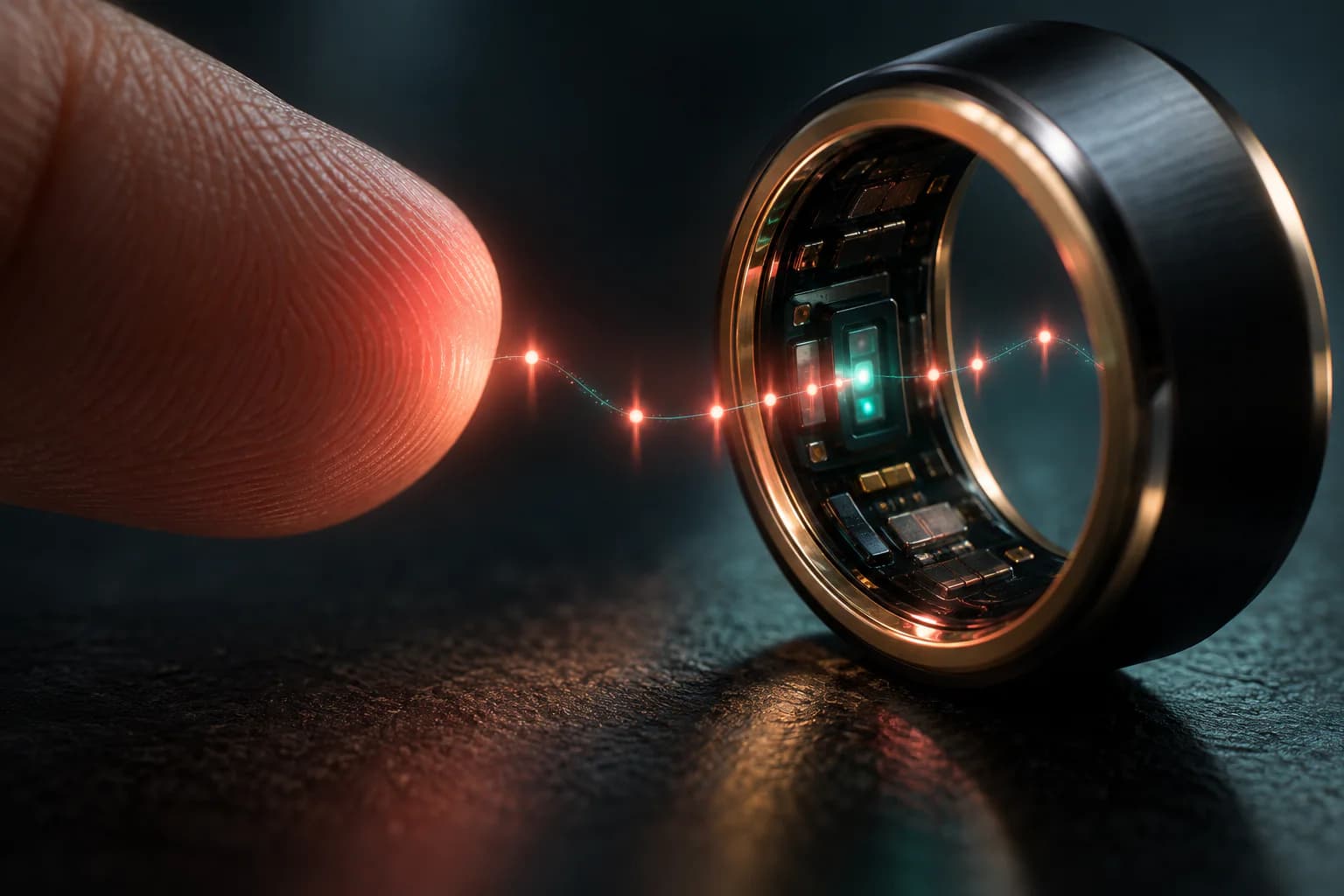
Short answer: Heart rate variability (HRV) describes variation in the timing between consecutive normal heartbeats. A smart ring normally derives a related measure from optical pulse waves at the finger, often during low-motion sleep. The result is most useful as a repeated personal trend collected with the same device and conditions—not as a universal score for stress, fitness or disease.
If your heart rate is 60 beats per minute, the heart does not normally beat exactly once every second. One interval may be 980 milliseconds, the next 1,030 and the next 990. HRV summarizes aspects of that changing timing.
That simple definition is easy to distort. HRV is not:
- the same as average heart rate;
- proof that a person is calm or stressed;
- a target that should rise every day;
- directly comparable across every app and device;
- a diagnosis of illness, overtraining or an abnormal rhythm.
The useful question is rarely “Is my HRV good?” It is: Was this a valid measurement, is it unusual for me, does it repeat, and what else changed at the same time?
HRV in One Table
| Term | What it means | Important caution |
|---|---|---|
| Heart rate | Number of beats per minute | Does not describe beat-to-beat variation |
| RR interval | Time between ECG R waves | Derived from the electrical heart signal |
| NN interval | Time between normal beats after artifact/abnormal-beat handling | Processing rules affect the result |
| Pulse interval | Time between peripheral pulse-wave features | Includes vascular pulse-transit effects |
| HRV | Variation calculated from cardiac beat intervals | Broad field with many metrics |
| PRV | Pulse-rate variability derived from peripheral pulse waves | Related to, but not always identical to, ECG HRV |
| RMSSD | Root mean square of successive interval differences | Common for short/resting comparisons; not the only HRV metric |
| SDNN | Standard deviation of normal intervals | Depends strongly on recording length and conditions |
| HRV score | App-specific summary | May not equal RMSSD or any standard metric |
Before comparing two values, confirm they describe the same metric, units, time window and measurement method.
What HRV Actually Represents
Heart timing is continuously adjusted by interacting physiological systems. The autonomic nervous system is central to this regulation.
- The sympathetic branch supports mobilization during demand.
- The parasympathetic branch supports functions associated with rest, digestion and recovery.
The common “fight or flight versus rest and digest” explanation is useful but incomplete. Both branches are necessary, can operate together and do not map onto a simple bad/good scale.
HRV is influenced by:
- breathing pattern;
- sleep and circadian timing;
- posture;
- physical activity and training load;
- age and individual physiology;
- illness and inflammation;
- alcohol, nicotine, caffeine and other substances;
- medication;
- heat, hydration and altitude;
- psychological state;
- menstrual-cycle and hormonal factors;
- the device, signal processing and HRV metric.
An HRV change therefore has low specificity. It can tell you that timing variability changed, not why it changed.
Heart Rate and HRV Are Different
Two people can both have a resting heart rate of 60 bpm and very different interval patterns.
Example A:
1000 ms → 1000 ms → 1000 ms → 1000 ms
Example B:
930 ms → 1060 ms → 970 ms → 1040 ms
Both examples average near 60 bpm. The second has more short-term variability.
The same person can also have a similar average nighttime heart rate on two nights while HRV differs. Looking at both can provide more context than either alone, but neither reveals the cause by itself.
How a Smart Ring Derives HRV
Most consumer smart rings do not record a continuous clinical electrocardiogram. They use photoplethysmography (PPG).
1. Emit and detect light
LEDs illuminate tissue in the finger. A photodetector observes changes in reflected light as local blood volume changes with each pulse.
2. Build a pulse waveform
Signal processing identifies repeating pulse features. Motion, poor contact and weak peripheral circulation can distort them.
3. Estimate pulse intervals
The software estimates the time between successive pulse-wave features. These are pulse-to-pulse intervals, not ECG RR intervals.
4. Assess quality and remove artifacts
Algorithms may exclude intervals affected by motion, missed peaks, extra detected peaks or poor contact. The rules used here can materially change the final value.
5. Calculate an HRV-related metric
Many consumer devices emphasize RMSSD during rest or sleep. Some transform it, average selected windows or convert it into a proprietary score.
6. Create a nightly summary
The app may report an average, median, maximum, selected stable segment or another aggregate. Two devices using RMSSD can still differ because their accepted intervals and summary windows differ.
HRV, PRV and ECG: Why the Names Matter
ECG detects electrical depolarization in the heart and measures R-wave timing. PPG detects the peripheral pulse after the pressure wave travels through the vascular system to the finger.
Under quiet, stable conditions, pulse-rate variability can agree well with ECG-derived HRV for some metrics and devices. They are not physiologically identical in every condition because pulse transit is affected by vascular tone, blood pressure, temperature and other factors.
The distinction matters most when:
- movement is present;
- fingers are cold;
- vascular conditions change;
- irregular beats occur;
- precise clinical interpretation is required.
It is reasonable for a wellness app to use the familiar term HRV if the method is explained. It is not reasonable to imply that all PPG measurements are interchangeable with every clinical ECG protocol.
What RMSSD Measures
RMSSD stands for root mean square of successive differences.
In simplified terms:
- Find the difference between each pair of consecutive accepted intervals.
- Square each difference.
- Average the squared differences.
- Take the square root.
The result is normally expressed in milliseconds. RMSSD emphasizes short-term beat-to-beat variation and is often used in resting and nighttime wearable analysis.
Why apps may show lnRMSSD
HRV values often have a skewed distribution. Research and training systems sometimes use the natural logarithm of RMSSD, written lnRMSSD, to make variation easier to analyze statistically.
An RMSSD of 50 ms and an lnRMSSD value are not on the same scale. Do not compare them directly.
RMSSD is not the entire HRV field
SDNN, frequency-domain measures and nonlinear metrics describe different properties and require different recording conditions. A 24-hour SDNN value cannot be compared with a five-minute or selected-night RMSSD as though both were one universal score.
Why Rings Often Measure HRV at Night
Sleep offers longer low-motion periods and relatively repeatable posture. This reduces one major source of PPG error and allows the device to select cleaner segments.
Nighttime is not perfectly standardized. HRV can vary across sleep stages and be influenced by:
- awakenings and movement;
- bedtime and measurement window;
- breathing disturbances;
- room temperature;
- alcohol or late meals;
- illness;
- previous exercise;
- sleeping on the hand;
- how the app summarizes the night.
Nightly values are useful because conditions are more comparable than random daytime moments, not because every night is identical.
What Is a “Good” HRV?
There is no universal target that applies to everyone.
Age is associated with population-level differences, but an age chart cannot account for your physiology, medication, health, training, device or measurement protocol. A value typical for one healthy person may be unusual for another.
Instead of asking whether 40 ms is good, ask:
- Is this the same metric and device as my earlier data?
- Was the ring worn on the same finger under similar conditions?
- Is the value inside my established personal range?
- Is the change isolated or repeated?
- Did resting heart rate, sleep, temperature, training or symptoms also change?
A personal baseline does not create a medical reference range. It creates a practical comparison for your own wellness trend.
Is Higher HRV Always Better?
No.
A higher value relative to your normal range can coincide with favorable recovery conditions. But unusually high HRV can also result from:
- pulse-detection artifacts;
- missed or extra pulse peaks;
- irregular beats;
- a changed calculation window;
- a different finger or device;
- firmware or algorithm updates;
- normal biological variation.
The goal is not to maximize HRV every night. It is to understand a stable, valid pattern and respond proportionately when several pieces of evidence change together.
Why HRV May Be Lower Than Usual
| Possible factor | What to check before concluding |
|---|---|
| Short or fragmented sleep | Sleep opportunity, awakenings and trend across several nights |
| Alcohol | Amount, timing, nighttime heart rate and sleep disruption |
| Hard training | Recent load, soreness, warm-up performance and recovery days |
| Psychological strain | Subjective stress and whether the pattern repeats |
| Illness or inflammation | Symptoms, temperature trend and resting heart rate |
| Heat or dehydration | Environment, fluid intake and overnight comfort |
| Travel or jet lag | Time-zone shift, bedtime and sleep duration |
| Medication or substances | Known effects and recent changes; discuss concerns professionally |
| Hormonal changes | Personal cycle pattern rather than a universal expectation |
| Poor signal | Fit, cold fingers, motion, missing data and device update |
This table is a list of contexts, not a diagnostic tool. The same pattern can have different explanations.
First Decide Whether the Measurement Is Valid
Before interpreting physiology, check signal conditions.
Fit
The ring should resist casual rotation without causing pressure symptoms. A loose ring can lose optical contact; an excessively tight ring is not a valid solution.
Completeness
Was enough nighttime data recorded? A precise number derived from a short selected interval may not represent the whole night.
Consistency
Did you change finger, hand, device, settings or firmware? These changes can shift the baseline.
Plausibility
Does the value move with other supported signals, or is it an isolated extreme surrounded by missing data?
Repetition
Does it recur across comparable nights? One outlier deserves verification before action.
A Practical Interpretation Decision Tree
If the value is unusual once
- Check fit, gaps, battery and synchronization.
- Note alcohol, illness, travel, heat and hard exercise.
- Avoid a major decision based on that night alone.
- Observe the next comparable night.
If it remains unusual for several nights
- Compare nighttime resting heart rate.
- Review sleep duration and continuity.
- Check temperature and activity context.
- Consider a small, low-risk adjustment such as easier training or earlier sleep.
- Pay attention to symptoms.
If the value is unusual with concerning symptoms
Do not troubleshoot the score instead of the person. Seek appropriate medical care for chest pain or pressure, fainting, severe shortness of breath, sudden weakness or other urgent symptoms according to local guidance.
Building a Personal Baseline
Use at least 14–21 ordinary nights
A baseline formed from two excellent weekend nights is not representative. Include normal workdays, training and routine variation, but exclude nights with obvious recording failure.
Keep the method stable
- Same ring and app metric.
- Same preferred finger.
- Similar overnight wear window.
- No deliberate switch between RMSSD and an app score.
Prefer robust summaries
Medians and rolling ranges are less dominated by one extreme value than a simple average. If the app does not show them, look at the broad band where most recent nights fall.
Rebuild when conditions change
Major changes in device, firmware, medication, training phase, altitude or health can make the old comparison less relevant. Note the date rather than forcing one permanent baseline.
A 14-Night Personal Experiment
This is a wellness exercise, not a clinical trial.
Nights 1–7: observe
Keep your routine normal. Record bedtime, alcohol, late exercise, illness, travel and unusually high perceived stress.
Nights 8–14: change one factor
Choose one realistic action:
- Keep bedtime within a consistent window.
- Move caffeine earlier.
- Avoid alcohol.
- Replace late intense exercise with a lighter session.
- Add a brief wind-down routine.
At the end, ask:
- Did HRV change consistently or only once?
- Did sleep and resting heart rate change too?
- Did you feel different?
- Were measurement conditions comparable?
- Is the effect useful enough to influence your routine?
Do not test several changes simultaneously if you want to know which one may be associated with the result.
HRV for Training Decisions
HRV can add context to recovery, especially when collected consistently at rest. It should not make the entire training decision.
Combine it with:
- sleep quantity and continuity;
- resting heart rate;
- soreness;
- mood and motivation;
- recent workload;
- warm-up performance;
- symptoms;
- demands of the planned session.
One low night does not automatically require rest. One high night does not guarantee readiness for maximal effort. HRV-guided training protocols use repeated standardized measurements and defined rules, not ad hoc reactions to a single app color.
HRV and Psychological Stress
HRV can be associated with autonomic responses to stress, but it is not a direct stress meter.
Exercise, poor sleep, illness, heat, alcohol and medication can produce overlapping changes. A low value cannot identify which cause is responsible. Feeling stressed also does not guarantee a particular HRV response.
A defensible statement is:
“My nightly HRV has been below its usual range for several days, and my workload, sleep and perceived stress also changed.”
That preserves useful context without turning the wearable into a psychological diagnosis.
HRV and Illness
Research links HRV patterns with many health states at population level. A consumer value is still nonspecific. Lower HRV can appear before, during or after illness, but it can also appear after alcohol, training or poor sleep.
Use the trend as a prompt to inspect symptoms and other signals. Do not use it to confirm infection, decide that you are not contagious or replace an appropriate test or professional assessment.
Can HRV Detect an Irregular Rhythm?
No. HRV analysis and rhythm diagnosis are different tasks.
Irregular beats can increase apparent interval variability or degrade PPG quality. An unusually high or unstable number cannot identify the rhythm. ECG and clinical interpretation may be needed.
Seek professional advice for palpitations, fainting, chest discomfort, severe breathlessness or repeated abnormal pulse alerts. Unless an exact feature has specific authorization, a wellness ring should not be described as diagnosing atrial fibrillation or another arrhythmia.
Can HRV Predict a Heart Attack?
No consumer HRV value can reliably predict that an individual heart attack is about to happen. Population associations do not create a personal alarm system.
Normal or high HRV does not rule out cardiovascular disease. Low HRV has many possible causes. Seek emergency care for warning symptoms according to local guidance and do not wait for the app to change.
How Accurate Is Smart-Ring HRV?
Accuracy depends on the exact model, metric, signal quality, participant and condition.
Research on wearable PPG suggests better agreement with ECG during rest than during exercise or non-stationary conditions. Some ring studies report good nighttime agreement for heart rate and RMSSD in the participants tested.
Evaluate evidence in layers:
- Pulse signal: is the waveform usable?
- Interval detection: are pulse peaks timed correctly?
- Artifact handling: are unreliable sections removed appropriately?
- Metric: is RMSSD or another standard method clearly defined?
- Night summary: which periods were selected and aggregated?
- Interpretation: does a recovery or stress claim go beyond the measurement evidence?
Validation of one model cannot be transferred automatically to another.
Reading EnergyMo HRV Responsibly
EnergyMo uses supported finger-based optical sensing to organize nightly HRV alongside sleep, resting heart rate, temperature, activity and recovery-related context.
Use it in this order:
- Confirm the night was recorded completely.
- Check whether the value is inside your recent personal band.
- Compare resting heart rate and sleep.
- Add activity, alcohol, illness, travel and subjective context.
- Look for repetition before changing plans.
- Choose a small, reversible action when appropriate.
Review the current EnergyMo Ring product details, supported health features and fit guide for model-specific information.
Frequently Asked Questions
What is HRV in simple terms?
HRV is variation in timing between consecutive normal heartbeats. It reflects changing regulation, not how fast the heart beats on average.
Is HRV the same as heart rate?
No. Heart rate is beats per minute. HRV describes variation between beat intervals. Two people can have the same heart rate and different HRV.
How does a smart ring measure HRV?
It uses PPG light sensors to detect pulse waves at the finger, estimates pulse-to-pulse intervals, removes low-quality segments and calculates a supported variability metric such as RMSSD.
What is a good HRV for my age?
Age influences population trends, but there is no universal personal target. Metric, device, recording window, fitness, health and medication also matter. Your stable trend under consistent conditions is usually the more useful wellness comparison.
Is higher HRV always healthier?
No. Higher relative to your baseline can coincide with recovery, but artifacts, irregular beats, algorithm changes and normal variation can also raise a value. Validity and context come first.
Why did my HRV drop even though I feel fine?
Normal variation, sleep, training, alcohol, heat, travel, medication, hormonal factors or signal quality may contribute. One night rarely identifies the cause.
Can HRV diagnose stress or anxiety?
No. It can add context about autonomic regulation, but it cannot identify psychological stress, diagnose anxiety or distinguish stress from other physiological influences.
Can HRV warn me before a heart attack?
No. Consumer HRV is not a heart-attack prediction tool. Respond to concerning symptoms and seek appropriate care regardless of the wearable value.
Sources and Editorial Notes
The term HRV is widely used in wearable interfaces, but PPG measures peripheral pulse timing. This article distinguishes PRV from ECG-derived HRV and does not present model-specific validation as universal evidence.
Sources reviewed:
- ESC/NASPE Task Force: HRV standards of measurement and interpretation
- Systematic review of wearable HRV measurement validity
- Heart rate variability measurement through a smart wearable device
- Pulse rate variability is not the same as heart rate variability
- Review of factors influencing HRV
- Systematic review of wearable-derived resting HRV and health outcomes
- Ring measurement of nocturnal heart rate and HRV compared with ECG
Last reviewed: October 12, 2026. EnergyMo SmartRing is a consumer wellness product. HRV and related scores are not intended to diagnose, treat, cure, prevent or predict disease.